Occupational Health and Safety
Occupational Safety Policy and Goals
Compal knows that employees, contractors, suppliers and workers are all important assets in the sustainable development of a company. Compliance with Occupational Safety and Health Act and other applicable requirements is therefore mandated during the development, testing, and mass production of company products. We also hope that all employees can grow in a safe working environment. We have therefore defined an Environmental Safety and Health Policy, which was approved by the Board of Directors and publicly announced on our official website. With this policy established, we have built an occupational safety management system, regularly conduct disaster prevention and fire drills, promote environmental safety training, and provide employees with recreational spaces to relax their minds and bodies after work. In addition to policy promotion, our dedicated occupational health and safety management units at each plant supervise and implement related activities. Each plant sets applicable performance targets in accordance with the Company's occupational health and safety policy, with the overall goal being zero occupational diseases and zero major occupational accidents, such as fires (fatal accidents are defined as major occupational accidents).
- Compal Environment Health and Safety Policy:

Occupational Safety and Health Management System
To safeguard employees’ occupational safety, Compal has not only established its Environmental, Safety, and Health Policy but has also developed Occupational Health and Safety Management procedures at each site. These procedures rigorously control workplace operations and details to ensure that employees and all on-site workers are not exposed to hazardous conditions or injured due to improper operations. The Occupational Health and Safety Management System covers both employees and on-site personnel. The system is implemented throughout the organization, from corporate management to regional occupational health and safety personnel, and is managed in accordance with international standards such as ISO 45001 or equivalent frameworks. Responsible personnel oversee the planning, implementation, supervision, auditing, and continuous operation of the system. Through procedural controls, regular monitoring and follow-up management, and the application of the Plan–Do–Check–Act (PDCA) management approach, the Company effectively strengthens workplace safety, prevents occupational injuries and illnesses, and safeguards employee health and well-being. Certified production sites currently include the Pingzhen Plant in Taiwan; the Kunshan, Chengdong, Chengdu, and Chongqing plants in China; the Vietnam Plant; and the Mexico Plant. Although other locations are not major production sites, Compal continues to actively plan for the gradual implementation and certification of ISO 45001.
Workers Covered by Occupational Health and Safety Management System
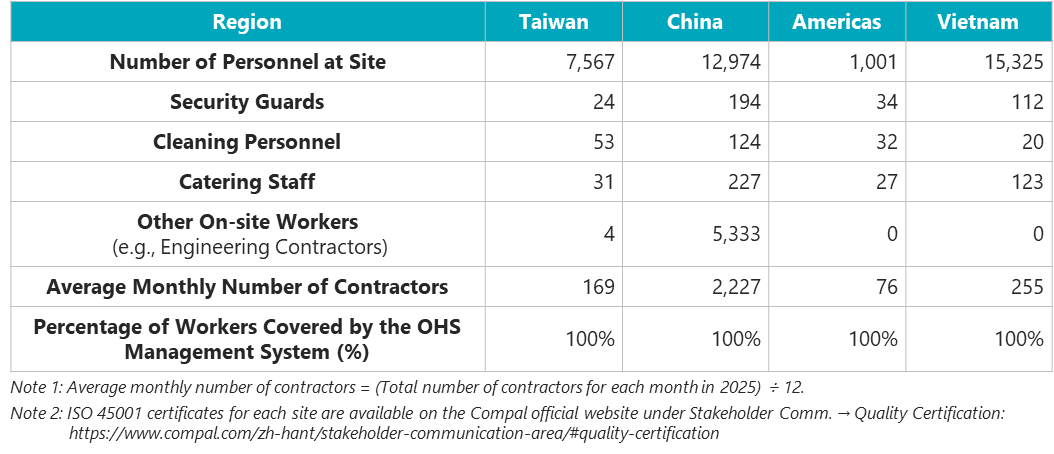
Compal manages its operations at each site in accordance with ISO 45001 or equivalent international standards. The workers covered by the Occupational Health and Safety Management System include employees, on-site personnel (including agency workers, interns, security guards, cafeteria staff, and other support personnel), contractors, and other relevant workers, ensuring that everyone working within Company premises is provided with a safe and healthy working environment.
Occupational Safety and Health Committee
In accordance with legal regulations, each plant in Taiwan has designated occupational safety and health management personnel who collectively plan and oversee all occupational safety and health matters. The sites regularly discuss occupational health and safety management, implementation plans for education and training, health management, occupational disease prevention and health promotion, self-inspections and safety audits, preventive measures for hazards associated with machinery, equipment, raw materials and substances, and occupational accident investigation reports, among other safety and health-related matters. In accordance with the "Regulations of Occupational Safety and Health Management to established an Occupational Health and Safety Committee composed of the employer/chairperson, department managers, occupational health and safety personnel, personnel responsible for occupational safety and health operations, and labor representatives. The Committee convenes once every quarter. Committee members provide recommendations on the Company’s occupational health and safety policies, review, coordinate, and advise on safety and health-related matters, and promote necessary improvements to operating procedures. Overseas sites also convene meetings regularly in accordance with their Occupational Health and Safety Management Systems.
Occupational Hazard Identification and Risk Assessment
The prevention of occupational injuries depends on protecting the physical health and safety of employees as well as the prevention and mitigation of negative OSH impacts. Hazard identification and risk assessment is conducted by Compal on employee work areas and any designated hazard factors on the shop floor are closely monitored to ensure their impact on employees is minimized. The scope of hazard identification and risk assessment include all health and safety hazards that may affect the inside and outside of the plant, but also include routine and non-routine activities, all personnel (including contractors and visitors) entering the plant, and outside contractors in the workplace. OSH hazard identification and risk assessments are conducted by the relevant task force (identification team). Moderate/high-risk or urgent hazards from the assessment findings are reported to the management review committee. The level of risk is then used to formulate the priority action plan for the year as well as devise the corresponding targets, specifications and management plans.
At the Pingzheng Plant in Taiwan, for example, the risk assessment taskforce conducts annual and ad hoc hazard identification operations, in accordance with the “Safety and Health Hazard Identification Form.” The results are recorded on the “Risk Assessment Form” to serve as a basis for policy formulation and hazard management. A management review meeting is convened periodically, and the promotion taskforce discusses newly identified risks before formulating and improving prevention and mitigation strategies. For risks already identified and content requiring revision, revision is further made.
◼Occupational Health and Safety Hazard Identification, Risk Assessment, and Control Process
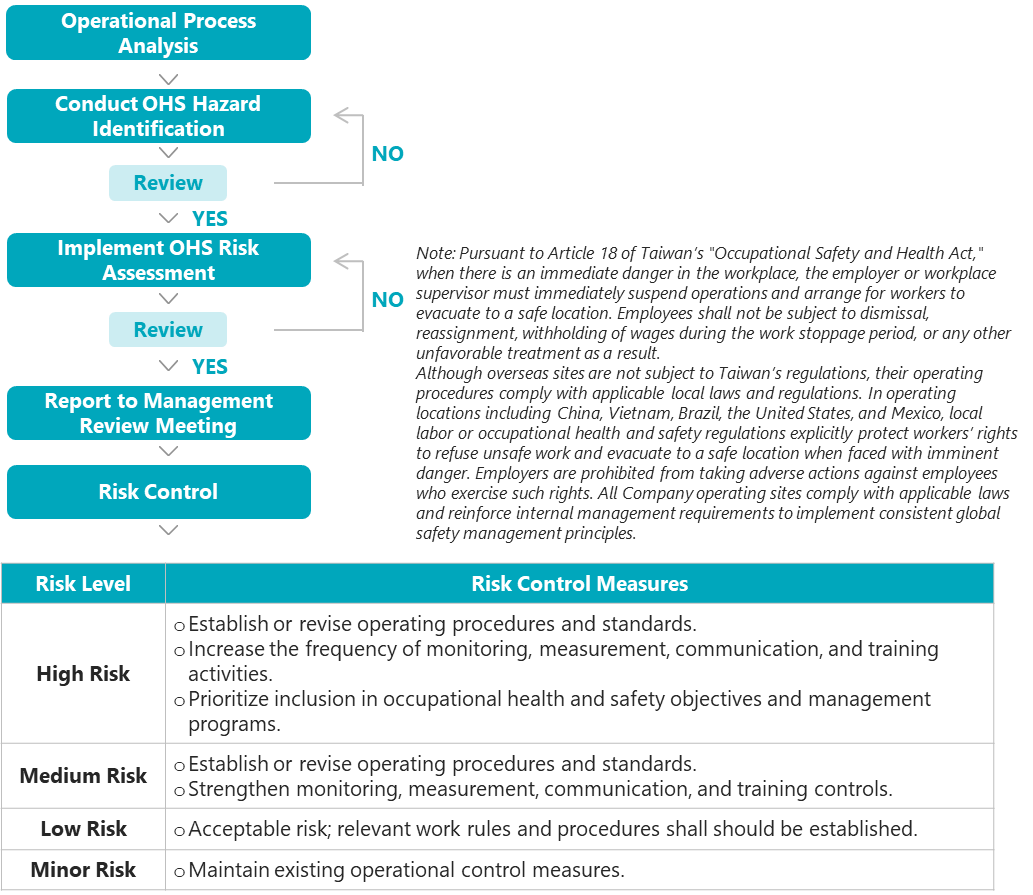
◼Occupational Health and Safety Hazard Identification, Risk Assessment, and Control Process
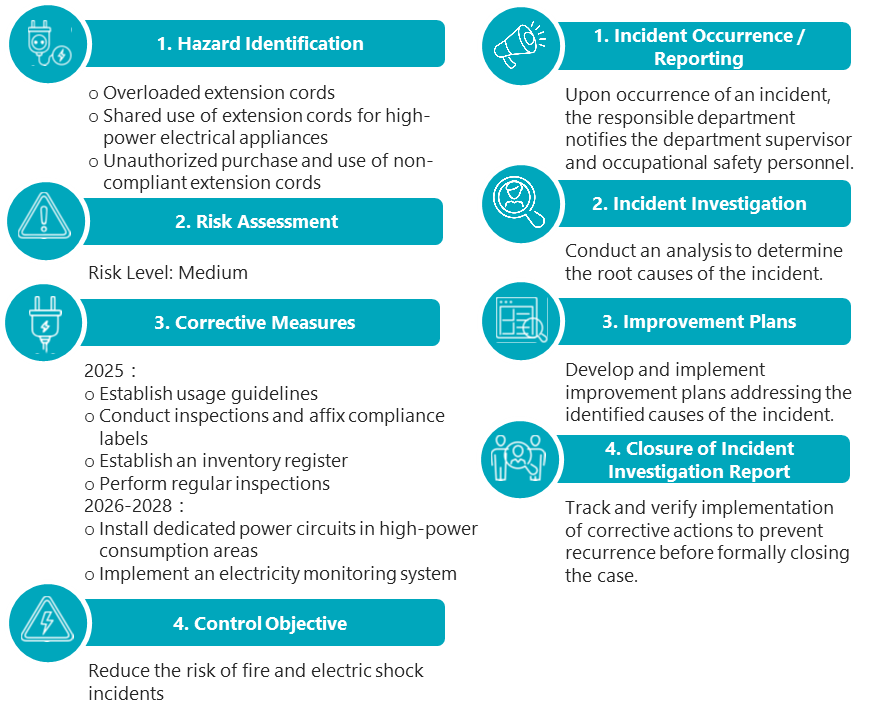
During the 2025 hazard identification and risk assessment process, the Pingzhen Plant identified improper use of electrical equipment and extension cords as a medium-risk hazard. The assessment determined that such practices could potentially result in electrical fires and electric shock incidents. Accordingly, the issue was designated as a priority improvement item.
In accordance with Company requirements, all Compal sites enter into contracts only with legally authorized labor service agencies. On-site personnel, including security guards, cafeteria staff, cleaning personnel, and other contracted workers, are protected under the terms of such contracts.
If an incident involving on-site personnel occurs, the incident shall first be reported to the individual’s direct team leader or manager, followed by notification of the site supervisor for on-site verification. Assistance will then be provided to facilitate medical treatment and insurance claims for the injured individual.
Emergency Response Measures and Occupational Disaster Investigation
All Compal sites maintain Emergency Preparedness and Response Procedures, which provide detailed documentation covering risk descriptions, emergency response organizations and responsibilities, preventive measures and internal reporting procedures, emergency incident response actions, external communications, and post-incident follow-up actions. The procedures also specify response processes for various types of risk events.
In the event of an occupational accident or injury resulting from a natural disaster within a Compal facility, the incident shall be handled in accordance with the Occupational Health and Safety Management System procedures. The responsible department must notify its supervisor and relevant personnel in accordance with established procedures and complete an incident investigation form to initiate the investigation process. Occupational accident investigations shall include, at a minimum, both environmental and human factors. Environmental factors include the workplace environment and equipment layout, the object or medium causing the injury, occupational health and safety measures in place, and the location where the incident occurred. Human factors include the circumstances surrounding the incident and rescue efforts, the condition of the injured person at the time of the incident, normal operating procedures and practices, and witness accounts and observations, if any. Traffic Accident Management: If a vehicle transporting Compal products is involved in an accident outside Company premises, the incident must be immediately reported to the transportation company responsible for the vehicle, which shall then notify the Occupational Safety Office. If the accident involves vehicle damage or personal injury, the local police authority must also be notified. Occupational Injury Management (including fatalities, disabling injuries, minor injuries, and commuting-related traffic injuries): The injured employee must first report the incident to their immediate supervisor and seek medical examination and emergency treatment. Regardless of the severity of the injury, the supervisor of the responsible department must notify the Occupational Safety Office within three hours of the incident. Taiwan sites are required to compile monthly occupational accident statistics and submit them online to the competent labor inspection authority through the Occupational Safety Office in accordance with applicable regulations. Detailed reporting procedures are implemented in accordance with relevant procedural documents.
In accordance with Company requirements, all Compal sites enter into contracts only with legally authorized labor service agencies. On-site personnel, including security guards, cafeteria staff, cleaning personnel, and other contracted workers, are protected under the terms of such contracts.
If an incident involving on-site personnel occurs, the incident shall first be reported to the individual’s direct team leader or manager, followed by notification of the site supervisor for on-site verification. Assistance will then be provided to facilitate medical treatment and insurance claims for the injured individual.

Access Control Implementation
To comply with the ISMS (Information Security Management System) regulations, employees are required to wear employee identification badges at all time in the plant site for identification. The access card system at each entrance and exit controls personnel's access authority. For clients, suppliers, and other visitors, a security system is used to record the time of visit, the number of visitors, and regulate the areas and time open to visitors. Compal's security personnel work 24 hours a day to control entry of personnel and objects, perform safety inspections day and night inside and outside plants, monitor the presence of visitors and overtime workers, check incoming/outgoing vehicles, and perform traffic control.
Workerplace Environment Monitoring
To provide a safe workplace and community for our staff and residents, each plant is staffed with a unit responsible for routine inspection and maintenance, as well as identifying hazardous factors in the work environment. Example: Transportation and electrical safety measures, safety inspection measures, drinking water testing, emergency lighting testing, smoke detector testing, firefighting equipment inspection, lightning protection testing, wastewater testing. Environmental monitoring in the workplace is arranged by each plant twice a year to measure the chemicals present or used on-site. Testing covers office illumination, CO2 concentration, electromagnetic radiation absorption, organic solvent concentration in the laboratory, noise, and chemical monitoring.
OSH-Compliance in Procurement Management
To ensure a safe and healthy environment for employees, the procurement of all machinery, equipment, raw materials and personal protection equipment used by the Company, as well as all building and construction work must stipulate supplier or contractor compliance with laws, regulations, and OHS specifications. Compliance must be verified during acceptance and before start of construction to reduce employee exposure to OSH hazards in the environment.
Occupational Safety and Health Education and Training
To cultivate employees’ occupational health and safety awareness and strengthen their understanding of job-related hazards, Compal regularly conducts general occupational health and safety training, professional knowledge and skills training, and emergency response training based on job responsibilities. Training programs include general occupational safety training for employees, chemical hazard communication training, emergency response drills, aerial work platform operation training, and training for supervisors of hazardous operations. In addition, fire safety training is conducted in accordance with the guidance of local fire departments. Disaster prevention awareness programs are provided annually to employees. Training materials are developed and delivered through the E-learning platform or in-person instruction, covering appropriate response measures for fire, typhoons, flooding, earthquakes, and other emergency situations. Employees are required to complete assessments after training, and only those who achieve a passing score are deemed to have successfully completed the training. In 2025, a total of 110,470 training attendances were recorded.
For non-employee workers, occupational health and safety awareness is reinforced through pre-entry hazard communication training, job safety analysis, safety briefings, and ongoing safety supervision during work activities. These measures help promote greater awareness of occupational health and safety culture among all workers.
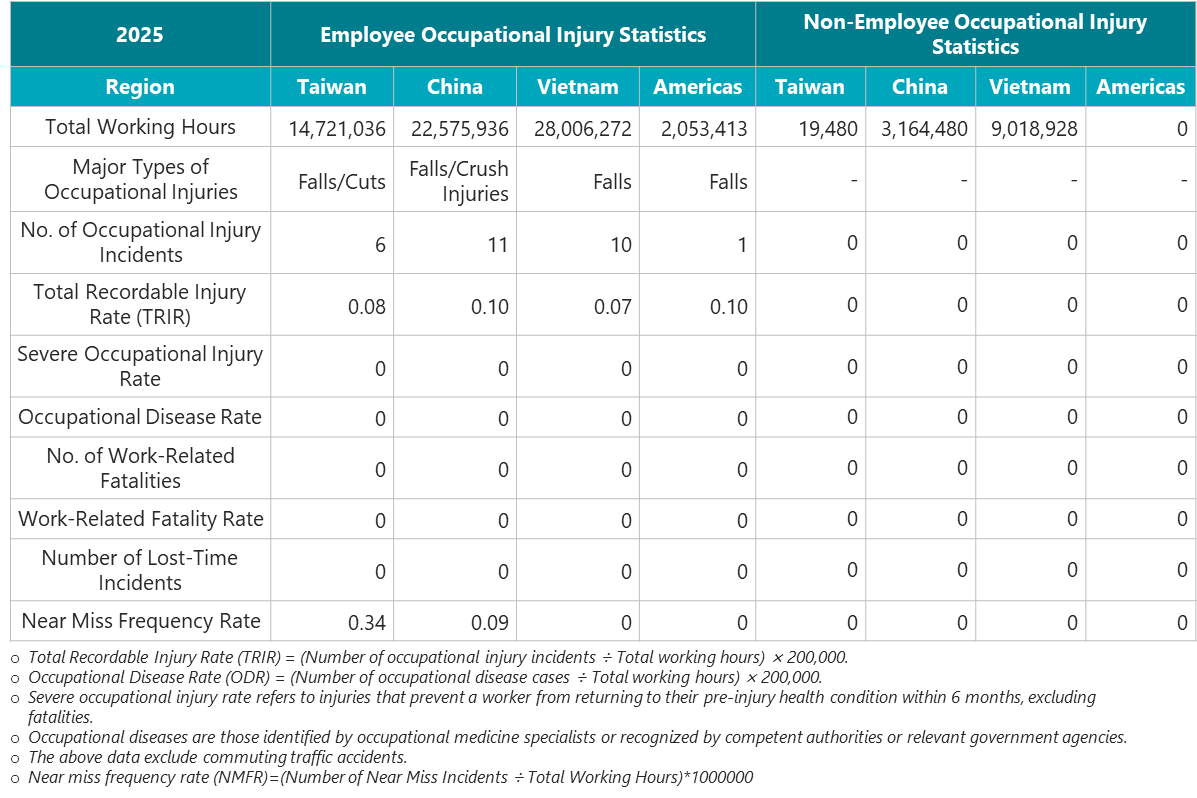
We are committed to establishing and maintaining a safe and healthy workplace environment to reduce employee absenteeism resulting from illness and injury and to sustain organizational productivity.
2025 Target: Absenteeism rate of 5%, with 100% global coverage. The absenteeism rate target was achieved.
Workplac Safety Management Procedures
Compal plants employ the following OSH management procedures to strengthen their safety management and minimize occupational.