Nature-related Management: TNFD and Biodiversity
Climate change and ecosystem degradation are recognized as key global risks over the coming decade. Natural capital is not only the foundation of human well-being, but also a critical driver of business continuity and resilience. To advance its vision of living in harmony with nature, the Company has aligned with the LEAP approach recommended by the Taskforce on Nature-related Financial Disclosures (TNFD) since 2024. Through a systematic assessment of the value chain’s dependencies and impacts on nature, the Company translates its environmental commitments into concrete actions that strengthen operational resilience and support sustainable development.
Nature Risk Management Process: LEAP Assessment Results
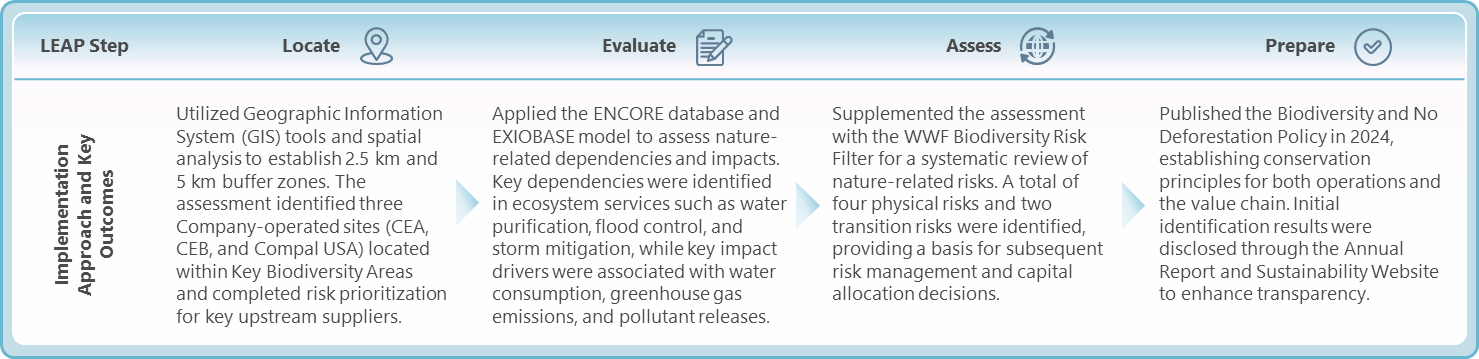
Nature-related issues have been incorporated into the Company’s overall transition and development framework. Through the implementation of the LEAP approach, a science-based management foundation has been established throughout the process, from location identification to action preparation:
Scope 3 Decarbonization Strategy
Through in-depth analysis of different business groups and the supply chain, the Company identified the interactions between its value chain and natural capital. The assessment results indicate that all business groups demonstrate significant dependencies on hydrological regulation ecosystem services, while resource consumption and emissions generated throughout operations also contribute to specific ecosystem impact drivers.
- Nature Dependency Analysis: Operational stability is highly dependent on ecosystem services such as water supply, flood control, storm mitigation, and water flow regulation.
- Nature Impact Analysis: Key impact drivers include water consumption, greenhouse gas emissions, disturbances (such as noise and light pollution), and toxic emissions to soil and water.
Nature-Related Risks, Opportunities and Response Measures
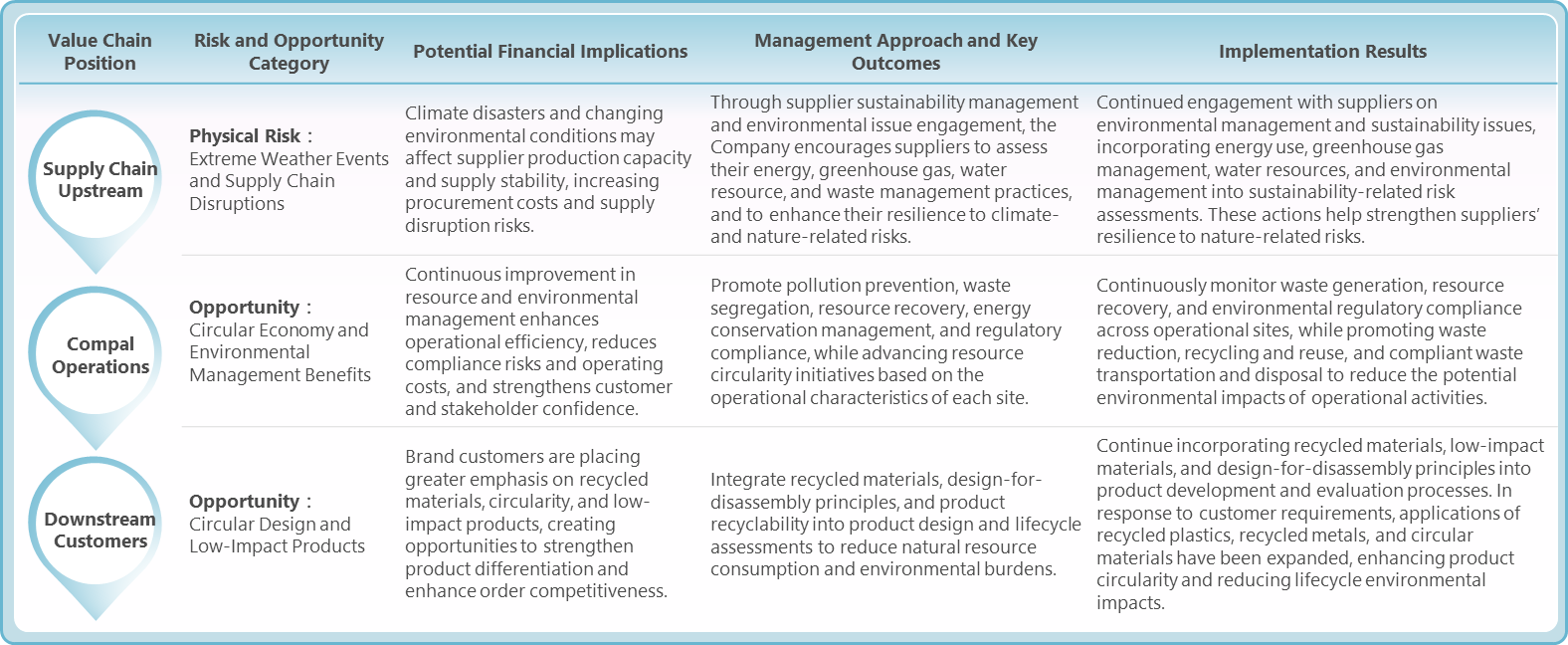
Through the assessment of material nature-related issues, the Company translates identified risks into opportunities to enhance operational resilience and aligns its assessment approach with the financial materiality principles of IFRS S2.
Management Strategy and the AR3T Action Framework
Management practices are guided by the AR3T Framework—Avoid, Reduce, Restore & Regenerate, and Transform—to support the Company’s long-term vision of achieving a Nature Positive future.
■ Ecosystem Protection and Digital Enablement:
•FMM Smart Monitoring (Amazon Rainforest): Leveraging edge computing and sensing technologies, the Company has established a monitoring network around its operations in Brazil to support the detection of illegal deforestation, demonstrating the tangible contribution of digital technologies to environmental protection.
•Curumim Youth Empowerment: Supporting Indigenous communities in the Amazon in establishing self-managed monitoring and patrol mechanisms, closely integrating ecosystem conservation with a just transition.
■ Water Resource Risk Management:
•Applied the WRI Aqueduct tool for ongoing water risk assessment, with the objective of reducing water consumption.
■ Biodiversity and Local Engagement:
• Pinglin Organic Tea Farm and Ecological Conservation
In 2025 and 2026, Compal invested approximately NT$200,000 annually to adopt around 0.5 hectares of organic tea farmland in the Pinglin area, supporting local organic farming and grass-cover cultivation. Located within the Feitsui Reservoir watershed, Pinglin features rich low-elevation mountain, forest, and stream ecosystems. Species observed in organically cultivated areas include the emerald tree frog, Taiwan blue magpie, pangolin, small Indian civet, Reeves’s muntjac, as well as a wide variety of birds, insects, and aquatic organisms. The diversity and abundance of insects and arthropods are also reported to be approximately two to three times higher than those found in conventionally managed tea farms.
By eliminating the use of pesticides and chemical fertilizers, organic farming practices help reduce the environmental impacts of agricultural activities on surrounding areas and support the maintenance of tea farm ecosystems and nearby habitats. Compal also organized a sustainable environmental education experience at the Pinglin organic tea farm, with a total of 120 employees from the Kinpo-Compal Group participating.
•Urban Green Space Adoption and Ecological Maintenance
In 2025, Compal invested approximately NT$1 million in maintenance costs to adopt around 0.51 hectares of Zhouzi No. 2 Park. Through continuous maintenance of park greenery and vegetation, Compal supports the environmental quality of urban green spaces.
In addition to providing recreational space, urban parks can serve as habitats, feeding grounds, and movement corridors for birds, insects, and other urban wildlife, helping maintain urban ecosystems and strengthen connectivity within the urban green network.
• Wetland Education and Marine Conservation Actions
In 2025, Compal organized two environmental education activities at Guandu Wetland, with a total of 105 employees and their family members and friends participating, as well as one wetland conservation service activity involving 51 participants. These activities encouraged employees to increase their awareness of biodiversity conservation and support the protection of vegetation within blue carbon ecosystems.
Compal also organized a Kinpo-Compal Group coastal cleanup activity. A total of 52 Compal employees participated, while overall participation across the Group reached 150 employees. The activity removed a total of 116 kilograms of marine debris, contributing to the protection of marine ecosystems and biodiversity.
Looking ahead, the Company will continue to strengthen data-driven management and enhance its capability to quantitatively assess nature-related risks. The Company is committed to progressively advancing toward the goals of No Net Loss and Zero Net Deforestation, ensuring that business growth and the natural environment remain in balance while upholding the core values of sustainable development.
No Deforestation Actions
To achieve the long-term goal of Zero Net Deforestation by 2050, Compal Electronics is implementing the following strategies to progressively fulfill its forest conservation commitment:
■ Forest Production Risk Assessment and Management: Completed a comprehensive inventory of forest production used in business operations, serving as the foundation for deforestation risk control and substitution planning.
■ Phased Transition to Forest-Friendly Paper Product : By prioritizing the use of forest-friendly materials such as Forest Stewardship Council (FSC), Programme for the Endorsement of Forest Certification (PEFC), or recycled paper, the Taipei headquarters has fully adopted paper certified by FSC and is expanding its application to outsourced printed materials. Compal’s facilities in China have also launched paper substitution initiatives to increase the adoption of forest-friendly paper products.
■ Alignment with Customer Sustainable Packaging Requirements: In line with brand customers’ sustainability policies and packaging requirements, Compal continues to adopt forest-friendly packaging materials to strengthen no-deforestation practices across the supply chain.
■ External Collaboration and Stakeholder Engagement: Collaborates with suppliers, partners, and other stakeholders to identify and mitigate potential deforestation risks and land-use impacts, promoting the sustainable management of natural resources.
■ Long-Term Commitment and Progress Monitoring: Compal aims to achieve Zero Net Deforestation by 2050.