Internal Carbon Pricing: Carbon Cost Management and Decision-Making
Internal Carbon Pricing (ICP) has become a key financial tool for implementing the Company’s low-carbon transition strategy. Following the validation of its Science Based Targets (SBTi) in 2024, the Company introduced the ICP mechanism to internalize carbon costs within business operations, encouraging each business unit to proactively identify climate-related risks and opportunities. Beginning in 2025, the mechanism has been formally linked to the performance management system, ensuring that carbon reduction awareness is translated into tangible operational decisions and implementation outcomes. The assessment scope of Compal’s internal carbon pricing mechanism covers Scope 1, Scope 2, and Scope 3 greenhouse gas emissions. Based on data availability, management feasibility, and relevance to business decision-making, the mechanism is being progressively applied to energy use, renewable energy procurement, energy-saving improvements, and value chain carbon reduction initiatives.
Objectives and Strategic Positioning
Internal Carbon Pricing (ICP) is applied across four core dimensions to enhance capital allocation efficiency and value chain resilience:
o Drive Low-Carbon Investment Initiatives: ICP is integrated into the investment evaluation process to incorporate carbon pricing into cost-benefit analyses. By assigning a cost to carbon emissions, the mechanism enhances the investment attractiveness of energy-efficient equipment and low-carbon materials, thereby encouraging capital expenditures (CapEx) that deliver energy-saving and decarbonization benefits.
o Strengthen Business Decision-Making and Risk Assessment: By linking ICP to the performance management system, carbon cost factors are incorporated into financial planning and decision-making. In addition, potential risks associated with carbon taxes, carbon fees, and emissions trading schemes are assessed across global operations through scenario analysis, enhancing the Company’s resilience to evolving climate policies and regulatory changes.
o Drive Value Chain Decarbonization: The Company plans to leverage ICP to strengthen the management of embedded carbon costs across the supply chain and identify emissions hotspots throughout research and development and procurement processes. By leveraging its industry influence, the Company aims to promote collaborative emissions reductions across the value chain.
o Support the Implementation of the Decarbonization Pathway: By evaluating external carbon-related risks alongside internal abatement costs, the Company prioritizes resources toward initiatives with higher emissions reduction benefits, ensuring that SBT milestones are achieved on schedule.
Calculation Methodology and Pricing Mechanism
To support emissions management and decarbonization planning, Compal applies an Implicit Carbon Pricing approach and has established 2030 as its near-term planning horizon.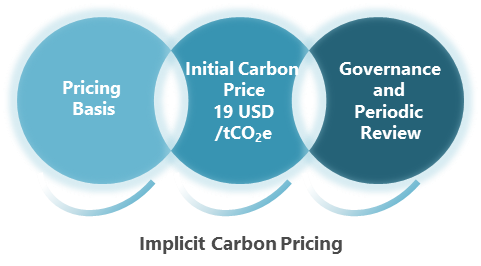
o Pricing Basis: The carbon price is determined with reference to multiple factors, including the Marginal Abatement Cost Curve (MACC) across global operations, regional carbon pricing regulations and market trends, international climate scenario analysis, and renewable energy procurement premiums.
o Initial Carbon Price: Based on a systematic assessment, the initial carbon price was set at USD 19/tCO₂e. The carbon price serves as a reference for evaluating renewable energy procurement, energy efficiency initiatives, and other decarbonization projects. Compal currently adopts an Implicit Carbon Pricing approach as the basis for its internal carbon pricing mechanism. The framework is further complemented by shadow pricing concepts to support long-term carbon cost assessments, climate scenario analysis, and low-carbon investment decisions.
o Governance and Periodic Review: The Sustainability Committee oversees the ICP mechanism and conducts regular reviews to adjust carbon pricing in response to technological advancements, market developments, and regulatory changes, ensuring that the mechanism continues to provide effective incentives for decarbonization and climate-related decision-making.
Integrated Applications and Management Practices
The ICP mechanism has been embedded into key business decision-making processes, ensuring that carbon cost considerations are translated into measurable management data.
Implementation Progress and Future Outlook
The Company has established an ICP assessment model, a periodic review mechanism, and cross-functional communication channels, and began linking ICP to the internal performance management system in 2025. Future development efforts will focus on the following areas:
o Enhance Value Chain Management Applications: Continue to assess value chain emissions and explore the integration of carbon pricing mechanisms into procurement and logistics management processes, encouraging suppliers to implement low-carbon measures.
o Strengthen the Linkage Between Strategy and Business Operations: Deepen the integration of ICP with performance evaluation mechanisms, encouraging business units to incorporate carbon emissions considerations into routine business assessments and supporting the implementation of decarbonization strategies.
o Maintain the Effectiveness of the Pricing Mechanism: Continuously monitor global market, regulatory, and technological developments, and periodically update carbon pricing levels to ensure the mechanism continues to guide the establishment and development of low-carbon business models.