Responsible Supply Chain
Sustainable Supply Chain Management Hierarchy
Compal places great importance on sustainable supply chain management. The Board of Directors serves as the highest governing body responsible for supply chain sustainability matters. Under the Board, the Sustainability Committee leads the promotion and implementation of sustainable supply chain management initiatives. The Committee is responsible for communicating policies and positions externally, defining objectives and strategic directions internally, integrating resources, reviewing action plans, and overseeing implementation performance. The ESG Office coordinates and reports annually to the Board of Directors on the execution status and achievements of sustainable supply chain management objectives.
Industry Supply Chain Overview
Compal's product portfolio spans a wide range of sectors. Its supply chain involves hundreds of suppliers providing panels, touch screens, camera modules, fingerprint recognition modules, batteries, chargers, charging cables, electronic components, electromechanical parts (printed circuit boards, flexible circuit boards, acoustic components, etc.), as well as mechanical components. The Company has established close and long-term partnerships with hundreds of suppliers to ensure product quality and performance. Through close collaboration with suppliers, Compal integrates diverse expertise and technological capabilities across the value chain to develop outstanding products that meet customer needs and expectations.
■ Supplier Production Location Distribution
To improve raw material sourcing, manufacturing, and supply efficiency, support local economic development, and reduce carbon emissions associated with transportation, Compal continues to promote its local procurement strategy. The Company supports and develops local suppliers, strengthens regional supply chains, enhances local manufacturing capabilities, and reduces dependence on overseas sourcing. Most suppliers are located near Compal’s major production bases, including its Taipei headquarters, manufacturing hubs in Sichuan and Eastern China, and northern Vietnam. Through these efforts, Compal is progressively building a comprehensive and resilient regional supply chain network. Based on the number of suppliers in 2025, the local procurement by supplier for each operations was 64% in Taiwan, 62% in China, and 18% in Vietnam. The total local procurement across Compal plants was 48%.

■ Supplier Classification
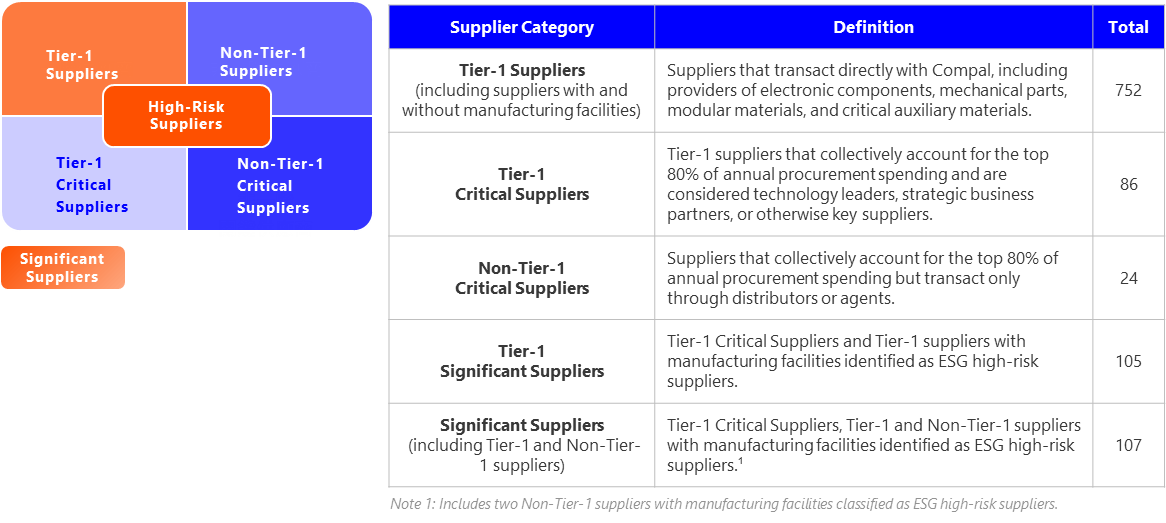
Compal's suppliers are distributed worldwide and provide a wide range of materials and components. To effectively manage ESG-related issues, suppliers are classified according to transaction models, procurement value, and various risk assessment criteria. Sustainable supply chain management activities are conducted based on the following supplier classifications. In 2025, Tier-1 Significant Suppliers accounted for 70.5% of the Company's total procurement spending.
Supplier Chain Management Mechanism
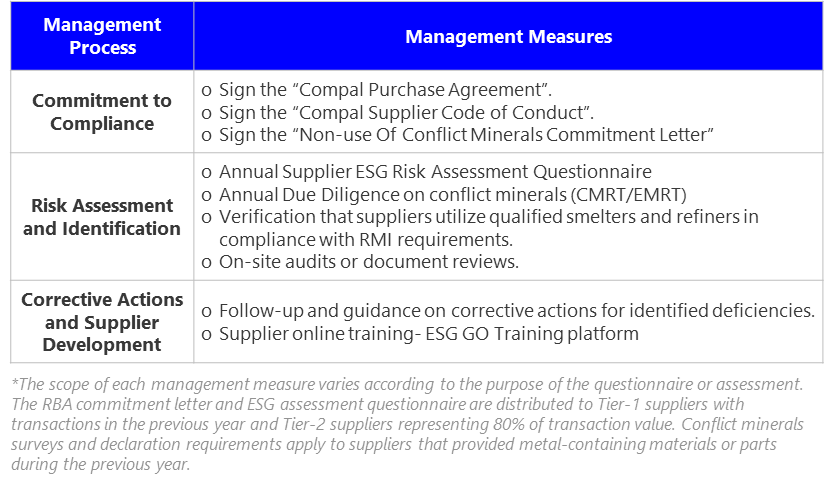
As a global leader in electronics manufacturing services and a member of the Responsible Business Alliance (RBA), Compal regards sustainable supply chain management as a critical element of its corporate development strategy. The Company is committed to ensuring that its products and services comply with international standards relating to ethics, environmental protection, and human rights. As part of its procurement process, Compal requires suppliers to sign the Compal Procurement Agreement and comply with international quality and environmental management standards. ESG performance is incorporated into supplier selection and management mechanisms, while internationally recognized ISO standards are progressively introduced to continuously enhance overall supply chain management performance.
To strengthen sustainable supply chain management capabilities, Compal conducts regular internal training programs for procurement personnel to enhance their understanding of the Company's sustainability objectives, as well as the frameworks and requirements of the RBA, the RMI, and CDP-related topics. A total of 215 procurement employees in Taiwan completed the relevant training programs, enhancing the procurement team's professional capabilities in ESG communication and supplier management. Through these efforts, Compal collaborates with suppliers to advance sustainable development and build a resilient and sustainable supply chain.
■ New Supplier Evaluation
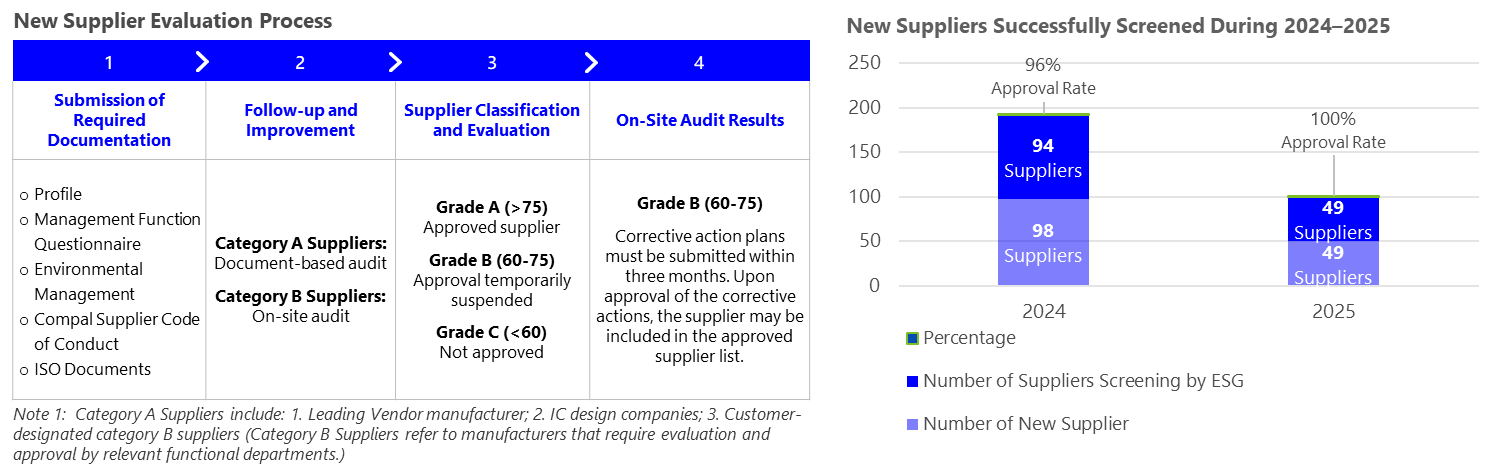
The sustainability performance and record of suppliers can indirectly affect Compal’s reputation or interests. To reduce potential risk, we engage in proactive screening for risk reduction when potential new suppliers are being assessed. Assessment factors include environmental, social, and governance (ESG) performance, operational status, country of origin, industry background, and product relevance. To further strengthen our supplier screening process, if there is a major international event, the regions, industries, and sources of supply involved are also investigated and analyzed to ensure the stability and continuity of the supply chain, while safeguarding the Company's reputation and interests. This ultimately enhances overall supply chain efficiency and resilience.
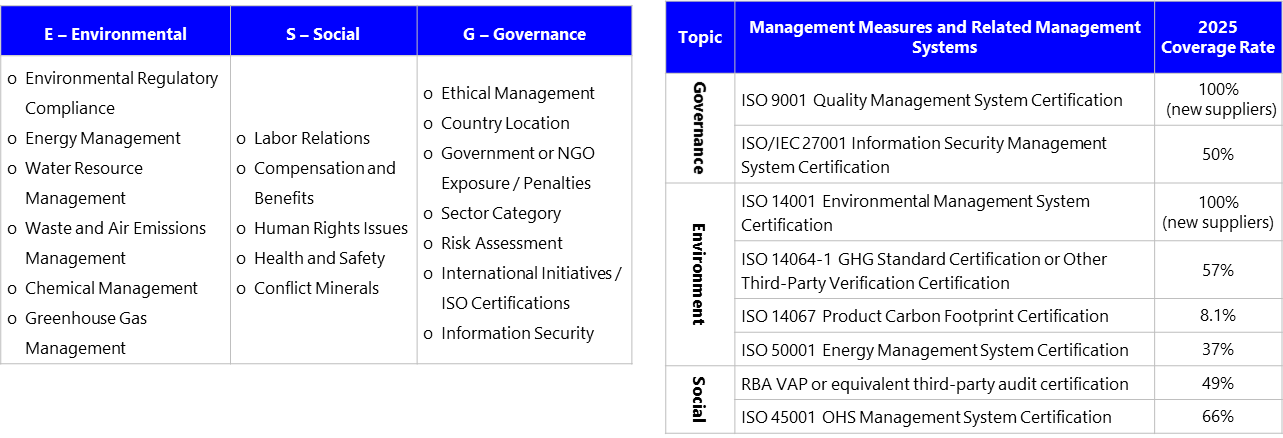
Compal has established ESG qualification requirements as part of its supplier onboarding process and incorporates ESG performance into supplier evaluation criteria, with ESG-related factors accounting for 19% of the overall supplier evaluation weighting. The ESG assessment covers environmental factors, including environmental management systems and policies as well as waste management; social factors, including occupational health and safety performance; and governance factors, including business strategy, information security protection, and supplier selection practices. An evaluation team composed of representatives from Procurement, R&D, Supplier Quality Engineering (SQE), and other relevant departments conducts supplier assessments through on-site audits, document reviews, or other appropriate evaluation methods. Suppliers rated as Grade A (Score>75) are included directly in the Approved Supplier List following evaluation. Grade B suppliers (Score 60~75) are subject to corrective action tracking by the relevant departments, and those that do not achieve Grade A status are included in the annual evaluation program for continuous improvement monitoring. Grade C suppliers are not approved. Supplier contracts may only be executed after all relevant departments have completed their evaluations and ratings.
■Suppliers Code Conduct
In alignment with the RBA Code of Conduct Version 8.0 and comprehensively integrating the Company's 14 sustainability policies covering five key dimensions—labor and human rights, health and safety, environmental protection, business ethics, and management systems—Compal has established and publicly disclosed the Compal Supplier Code of Conduct (Compal COC) on its official ESG website as the core framework governing sustainable supply chain management. Compal regularly reviews and ensures that its supply chain partners remain highly aligned with the Company's sustainability strategy and continuously updates the Code in response to international trends and material sustainability issues.
To enhance management efficiency and strengthen implementation, Compal fully adopted a digitalized management mechanism in 2025 by introducing an electronic signature process through its Vendor Integration Portal (VIP). The implementation achieved a 99% signing rate among Tier-1 Suppliers, Non-Tier-1 Critical Suppliers, and Tier-1 Critical Suppliers under MRO Procurement. The system automates document distribution, signature tracking, version control, and record retention, significantly improving document management efficiency and information transparency while strengthening internal audit capabilities and supply chain risk management.
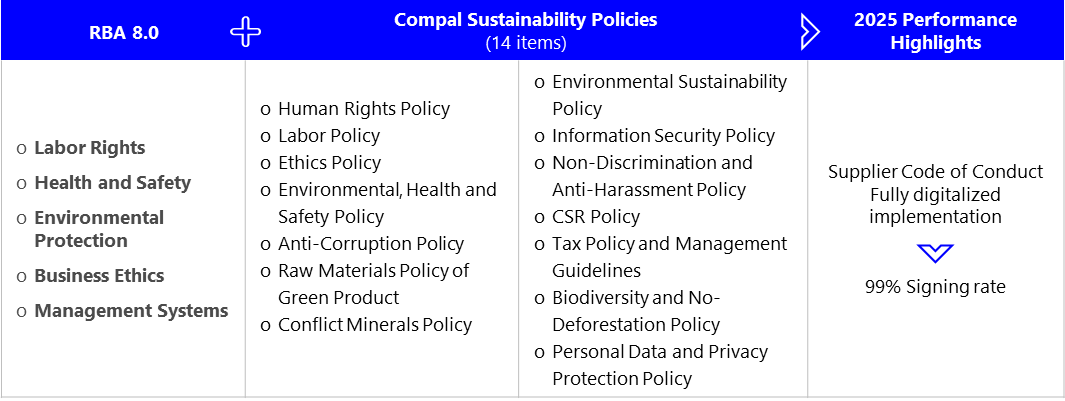
- Compal's Supply Chain Code of Conduct

Sustainable Risk Management
■ Risk Identification and Assessment
Based on the Responsible Business Alliance (RBA) Code of Conduct, Compal has developed a self-assessment questionnaire to evaluate supplier performance across labor practices, health and safety, environmental management, ethics, and management systems. In 2025, information security risk-related questions were incorporated into the assessment, and suppliers were also required to provide RBA SAQ, VAP, Non-VAP, CMA, or other equivalent customer-designated audit reports. Considering business relevance, a total of 776 suppliers were assessed, including Compal’s Tier 1 suppliers and Non-Tier 1 critical suppliers representing 80% of procurement spending, as well as 107 significant. The questionnaire achieved a 99% response rate. For the first time, the survey scope was expanded to include 293 MRO procurement suppliers, achieving a 100% response rate, thereby enabling a more comprehensive understanding of ESG risks across the supply chain. Suppliers that fail to cooperate with the assessment process are reported to the relevant departments, and the revocation of their approved supplier status may be recommended.
The ESG Risk Assessment Questionnaire classifies suppliers into high-, medium-, and low-risk categories based on the significance of ESG issues, while also taking inherent risks into consideration when selecting suppliers for audit sampling. Following the 2025 risk assessment, 5% of suppliers were advanced to the next stage of management and underwent internal or third-party document reviews, on-site audits, and improvement guidance to ensure compliance with Compal’s ESG requirements and to mitigate supply chain risks. In terms of supply risk management, Compal regularly reviews the resilience of suppliers’ global manufacturing footprints to ensure appropriate response measures can be implemented to maintain supply chain resilience in the event of geopolitical risks.
■ Greenhouse Gas Management Capability Identification
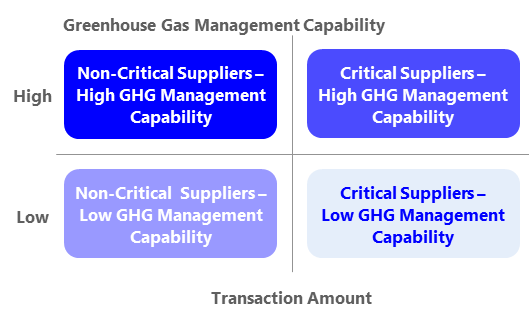
To achieve Compal’s Scope 3 greenhouse gas emission reduction targets, the Company analyzes suppliers based on the carbon intensity of their industries, their greenhouse gas management capabilities, and the strategic importance of their business relationship with Compal. Through this assessment, suppliers with significant decarbonization potential are identified, enabling the Company to develop future collaboration plans and engagement strategies related to greenhouse gas management and carbon reduction initiatives. In 2025, critical suppliers were invited to participate in the CDP environmental disclosure questionnaire. The primary assessment criteria included:
- Greenhouse gas inventory: Whether a greenhouse gas inventory has been conducted, its scope, and if it has been verified by a third party.
- International initiatives: Participation in international carbon reduction initiatives, such as the CDP, SBTi, or RE100.
- ISO international certifications: Whether relevant ISO international certifications have been obtained, such as ISO 14064-1 GHG inventory, ISO 50001 energy management system, ISO 14067 product carbon footprint inventory.
- Criticality of transaction with Compal: Suppliers with direct transactions representing the top 80% of Compal's annual procurement value.