Human Rights Management
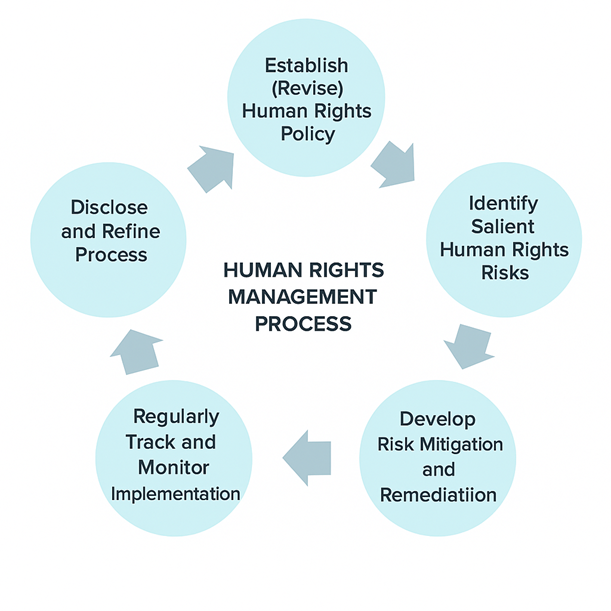
Compal has established a human rights management system that incorporates respect for human rights into its corporate governance and operational management framework. In accordance with the principles of human rights due diligence, the Company has developed a human rights management process to continuously identify, manage, and monitor human rights issues that may arise from its operations and value chain activities. Compal conducts a human rights risk assessment at least once every three years and discloses the assessment results and related management measures in both Chinese and English through its Sustainability Report and official ESG website to enhance transparency and strengthen stakeholder communication. In 2024, the Company completed a new human rights risk assessment, identifying salient human rights issues, and the related results were disclosed in the “2024 Human Rights Report”.
In 2025, the Company continued to follow its established human rights management process to monitor the effectiveness of the management measures implemented for the salient human rights issues identified in the previous year. It also regularly reviewed the implementation status of relevant management measures to further strengthen its human rights risk management mechanism.
Governance Structure and Roles & Responsibilities
To ensure the effective implementation and execution of this policy, Compal has incorporated human rights issues into its overall sustainability governance framework. Human rights-related policies, programs, and management matters are governed by the Board of Directors. Under the four dimensions of Economic, Environmental, Social, and Governance (EESG), the Board is responsible for oversight, while the Sustainability Committee supervises the implementation of related policies and management initiatives. Functional teams, including Human Resources, Responsible Manufacturing, and Sustainable Supply Chain Management, serve as the responsible units for managing and executing human rights-related matters. These units jointly promote human rights management initiatives, consolidate implementation results, and report regularly to the Sustainability Committee. The Sustainability Committee and the Board of Directors are responsible for overseeing the overall operation and effectiveness of human rights governance.
Management Mechanism
A: Convene meetings periodically and routinely, propose discussion on management status of topics and issues encountered to responsible units, and implement improvements. In addition, report the management status of topics to the ESG office periodically, and provide decisions on whether relevant projects are to be implemented or the management policy and strategy are to be revised. In case of encountering unanticipated topics, the meeting frequency is adjusted depending upon the situation.
B: Human rights training:
All employees of Compal, regardless of whether they are direct or indirect employees, undergo education and training on human rights related topics, in order to prevent human rights issues occurring and to enhance employees' awareness regarding such issues. Based on consideration of factors such as the employee workplace and working hours, an online course delivery method, offering greater flexibility, has been adopted.
The human rights education and training content includes:
- Introduction to human rights related laws and regulations: “International Bill of Human Rights","United Nations Guiding Principles on Business and Human Rights",“International Labour Organization Declaration of Fundamental Principles and Rights at Work",“Organization for Economic Co-operation and Development Guidelines for Multinational Enterprises",“The United Nations' Ten Principles of United Nations Global Compact" (UNGC)”and the“Responsible Business Alliance Code of Conduct (RBA)".
- Policy education: Compal's human rights policy, internal and external communication and complaint channel, future strategy and development goal.
Compal Human Rights Management Process
Human Rights Issue Risk Assessment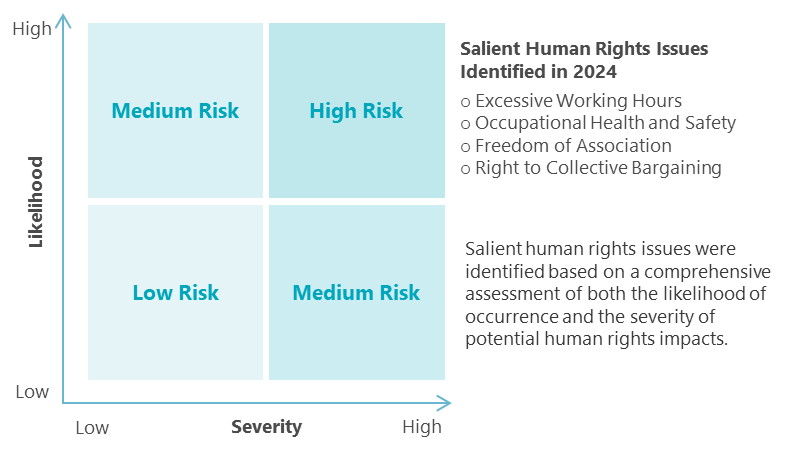
Compal identifies actual and potential human rights issues arising from its operational activities and value chain management through human rights risk assessments and incorporates these issues into its human rights management framework. In 2024, the Company completed a new human rights risk assessment and evaluated issues based on their Likelihood of occurrence and Severity of human rights impacts. Salient human rights issues were identified through a matrix analysis approach. Details of the assessment methodology and results are provided in the 2024 Human Rights Report. During the assessment process, the Company considered various stakeholder groups, including direct employees and specific groups such as female employees, indigenous employees, and migrant workers. Potential human rights risks were identified through existing management systems and information collection mechanisms. The 2024 assessment results identified the following salient human rights issues: excessive working hours, occupational health and safety, freedom of association, and the right to collective bargaining. In 2025, the Company continued to monitor and manage the salient human rights issues identified in the previous year. Through relevant policies, management measures, and questionnaire surveys, Compal reviewed changes in human rights risks and assessed the effectiveness of implemented mitigation measures.
Compal adopts a zero-tolerance approach toward child labor, forced labor, and human trafficking and incorporates these issues into its annual human rights risk assessment and management mechanisms in accordance with the Responsible Business Alliance (RBA) Code of Conduct and other relevant international standards.
The Company has established the Guidelines for Remediation Measures to Prevent the Employment and Misuse of Child Labor and the Policy on No Forced Labor, Non-Discrimination, and Anti-Harassment, which clearly define remediation measures for child labor and prohibit forced labor and related practices. Prevention and management efforts are further strengthened through grievance mechanisms and employee training programs.
Within the supply chain, suppliers are required to comply with the RBA Code of Conduct and the Supplier Code of Conduct. Risk management is conducted through supplier self-assessment questionnaires (SAQs) and other relevant management mechanisms.
Based on the 2025 human rights risk questionnaire surveys covering employees and contractors, as well as supply chain management assessments, no incidents of child labor, forced labor, human trafficking, retention of identity documents, forced overtime, or other improper labor practices were identified.
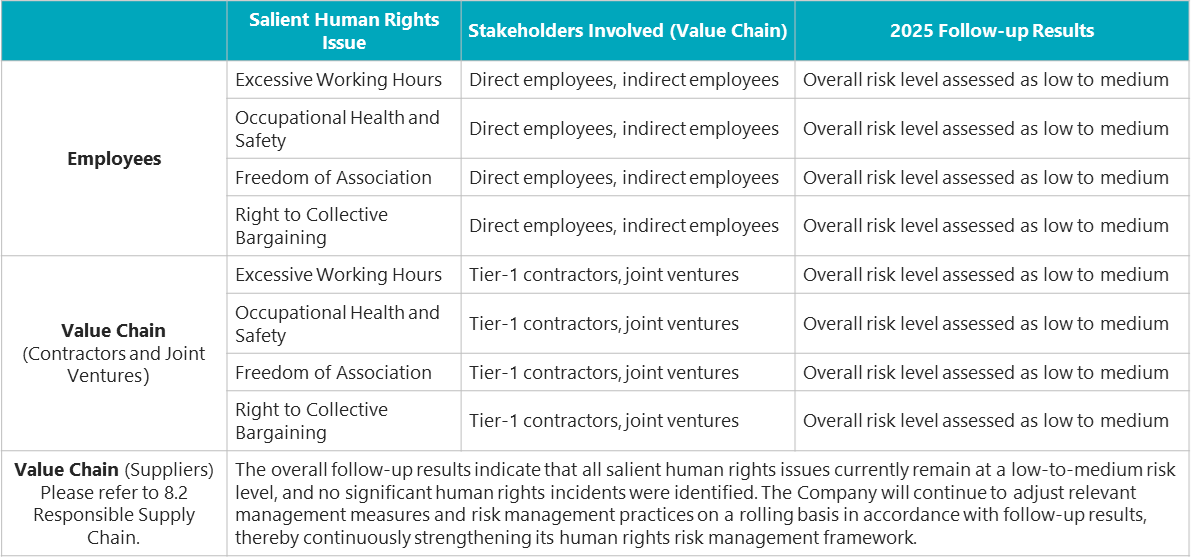
◼Follow-up Status of Salient Human Rights Issues (2024 Assessment / 2025 Follow-up)
In 2025, the Company continued to monitor and manage the salient human rights issues identified through the previous year's assessment. Human rights risk monitoring questionnaires were conducted among employees, contractors, and suppliers, supplemented by existing management systems and due diligence processes. The Company reviewed changes in human rights risks and tracked the implementation progress and effectiveness of relevant management measures.
◼Human Rights Mitigation & Remediation Tracking
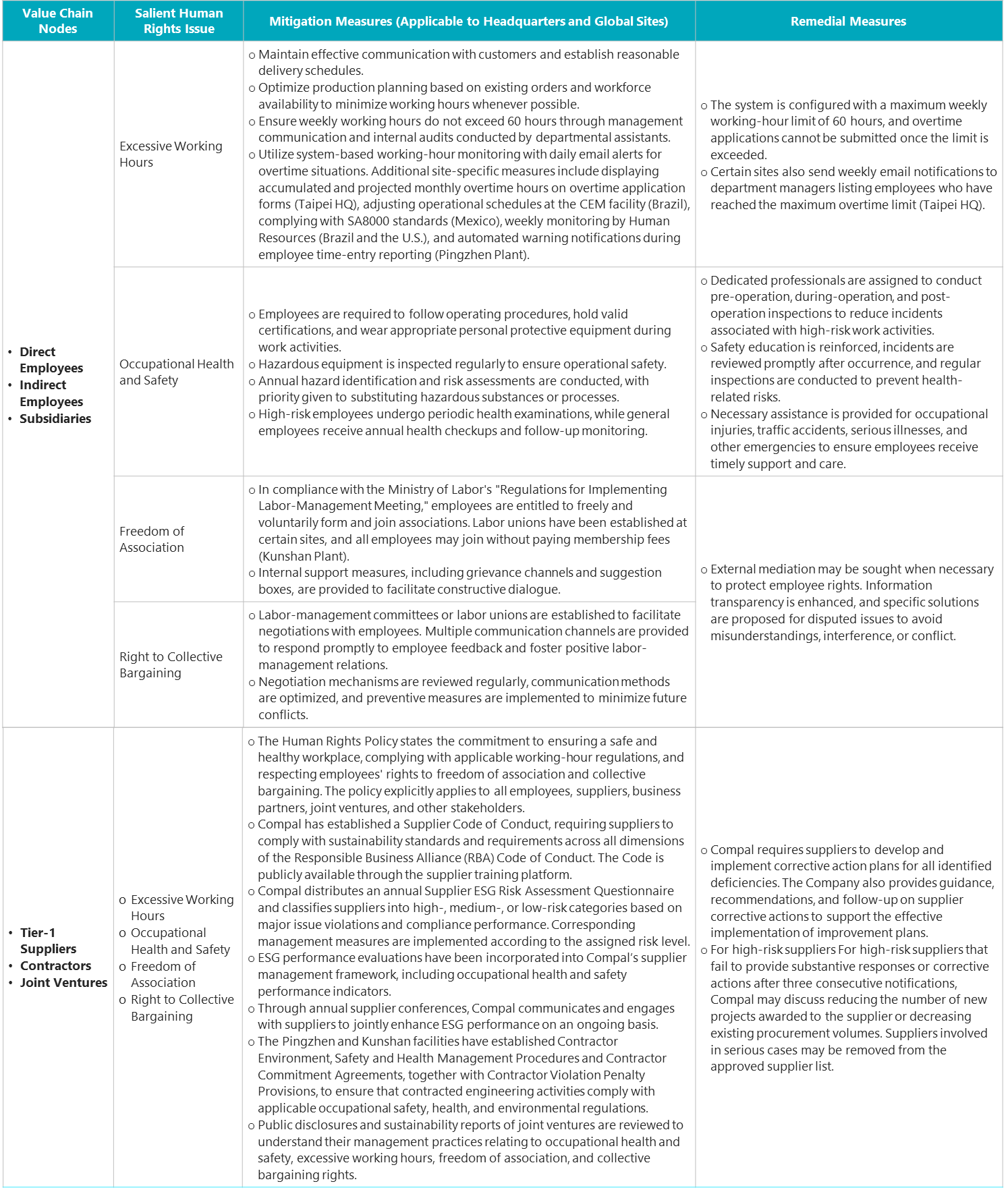
For the salient human rights issues identified through the human rights risk assessment, Compal has developed corresponding risk mitigation and remedial measures based on the assessment results and continues to implement related management actions through its existing management systems.
In 2025, the Company continued to monitor the implementation of these measures through established management mechanisms and adjusted relevant management practices on a rolling basis according to follow-up results in order to continuously strengthen human rights risk management. If potential human rights risks or related grievance cases are identified, the Company will address and remediate them through its established grievance and investigation mechanisms.