Green Product
To enhance the overall environmental performance of products, Compal continues to implement international eco-labels and materials disclosure management. In 2025, laptop products achieved registration under the U.S. EPEAT eco-label with 36 items, meeting green procurement standards across multiple countries, accounting for 78.53% of annual laptop revenue. ENERGY STAR® certified products also reached 48 items, representing 81.64% of annual laptop revenue, demonstrating Compal's commitment to energy conservation and carbon reduction during the product design phase.
At the same time, Compal is actively promoting material composition disclosure for products, strengthening the supply chain's responsiveness to regulations such as REACH and RoHS, and improving the prospect for non-toxic design and recyclability, thereby ensuring environmental responsibility across the product lifecycle.
Compal's Green Product Life Cycle
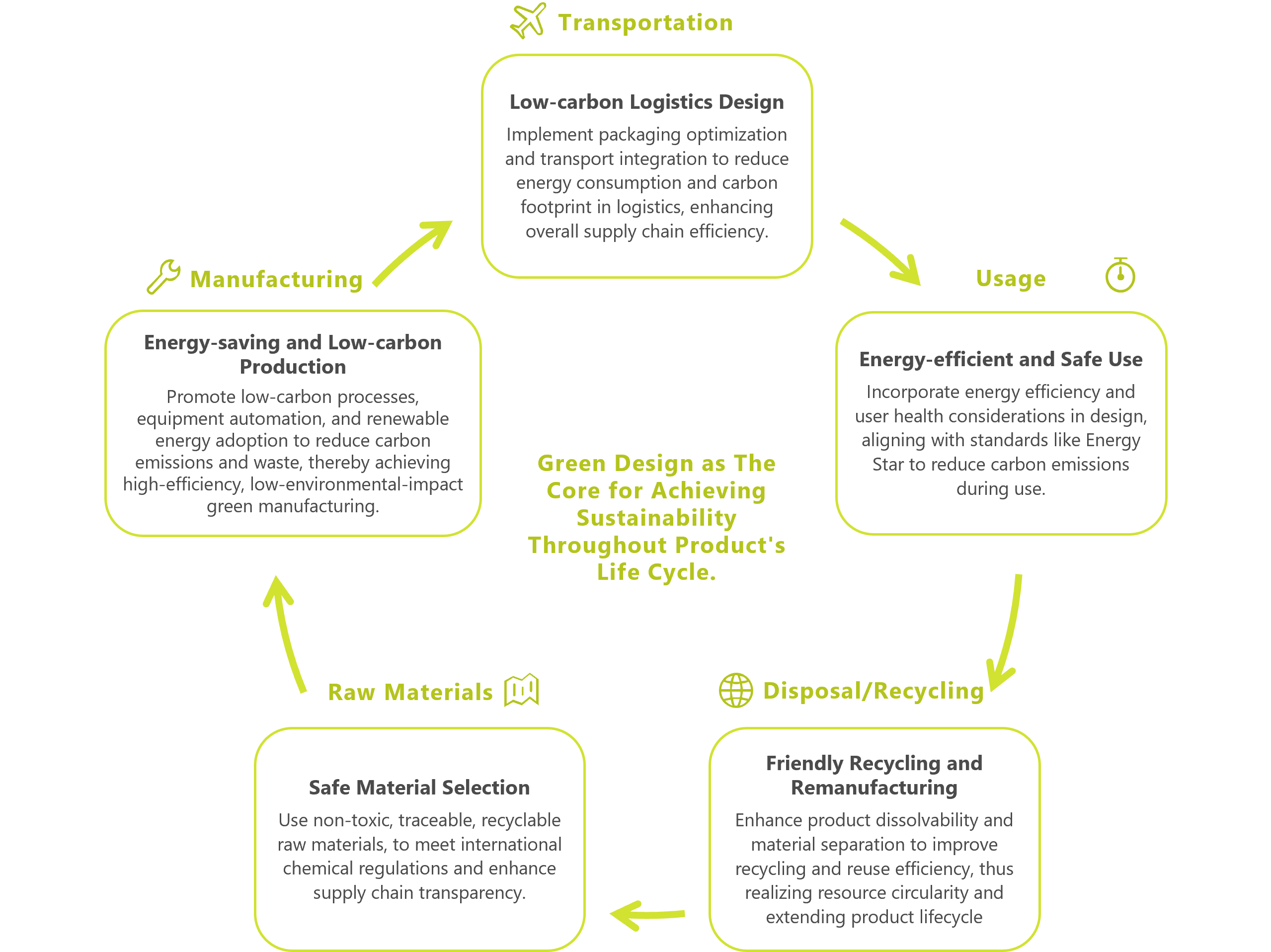
Green Design
2025 Green Product Outcomes
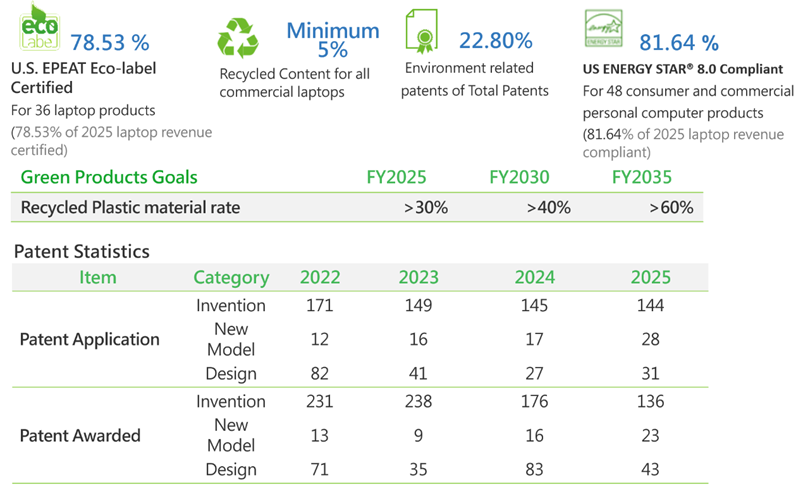
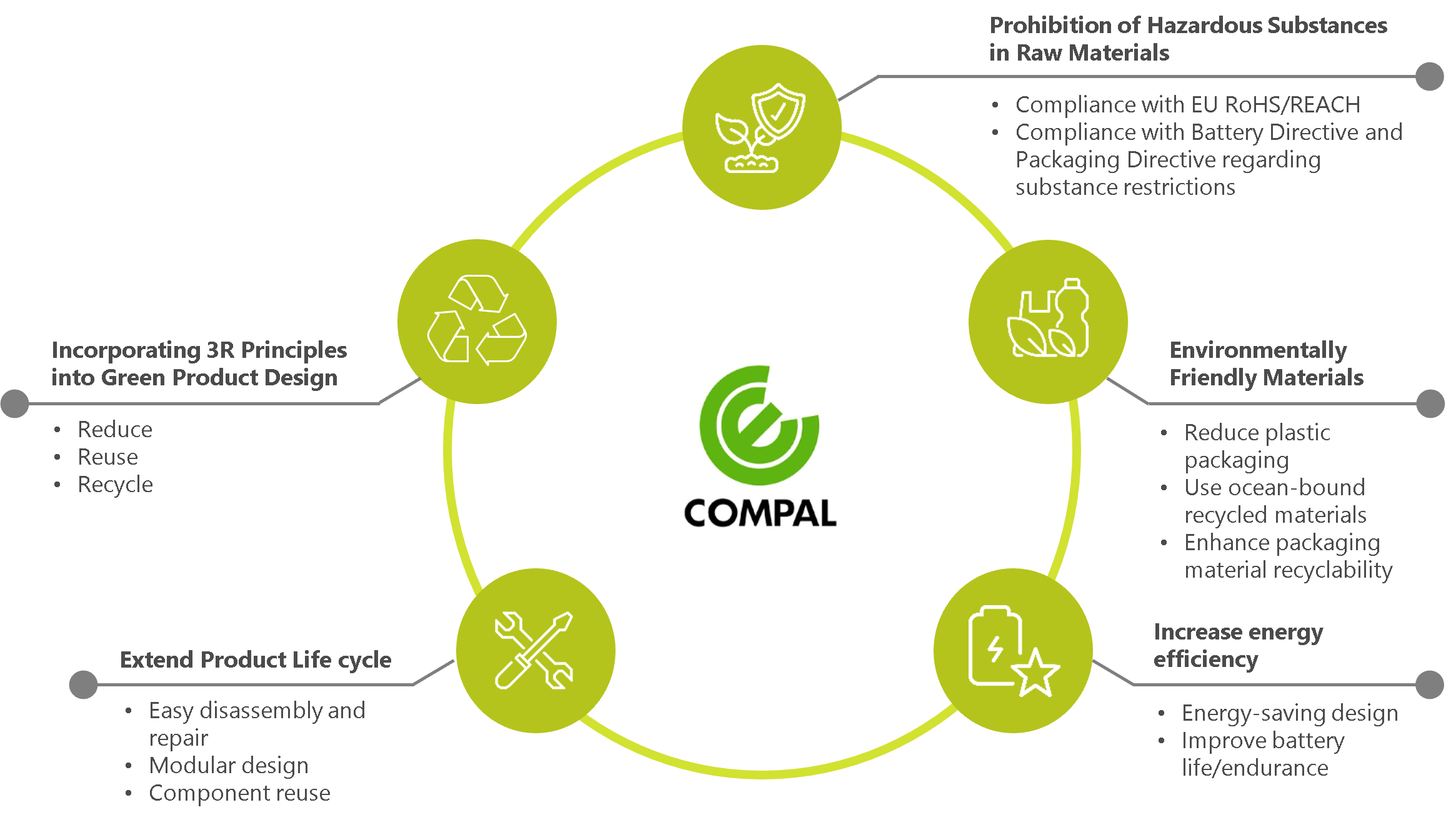
Compal is committed to creating green products that balance environmental value and competitive advantage, and integrating circular economy and full lifecycle management principles from the design stage. We emphasize material safety, energy efficiency, and recyclable design - for example, choose recycled plastics materials certified by UL2809 Standard - to support clients and supply chain partners in achieving low-carbon transitions and sustainability goals.
Green Product Design and Innovation Practices
Raw Material Management
To deliver healthy, safe, and high-quality products while addressing human rights and environmental issues, Compal has implemented systematic controls from the design and development stage since 2005 through its Integrated System for Product Development (ISPD). This ensures that all products comply with relevant international regulations, directives, and customer requirements. In parallel, Compal continues to utilize the COMPAL Supplier Design Collaboration Portal System to conduct material composition investigations, responding to updates in customer environmental standards and global environmental regulations. To support the upgrade of Compal’s Green Product Management System, certain sites have also introduced QC080000 hazardous substance management processes.
Compal’s commitment to customer health and safety goes beyond merely meeting customer requirements. We are dedicated to protecting customer health and safety, actively developing halogen-free products, and building a robust and responsible manufacturing capability—demonstrating our firm commitment and responsibility in this area. When selecting raw materials for products, relevant regulations are incorporated into the evaluation process to ensure that they comply with chemical requirements and human rights issues.
Raw Material Program
- Targets for Sustainable Material Use:
Recycled plastics with recycled content exceeding 40% have already been incorporated into product designs, and Compal continues to expand the application of diverse recycled materials. In 2025, 56% of innovation cases adopted recycled plastics containing more than 40% recycled content.
- Raw Material Prioritization and Assessment:
In addition to prioritizing raw materials based on applicable environmental regulations and standards, Compal conducts supplier ESG risk assessments and conflict minerals surveys to identify and manage potential environmental and social risks associated with the extraction and production of raw materials, with the objective of reducing potential adverse impacts.
- Raw Material Traceability:
Compal continues to establish a raw material traceability mechanism. At present, for recycled plastics, Compal has adopted the requirements of the UL 2809 Recycled Content Validation Program. Through supplier data collection and document verification, Compal seeks to ensure the traceability of recycled material sources and recycled content, including traceability to the source of recycled feedstock, thereby enhancing visibility into environmental information across the upstream supply chain.
Full Material Declaration
Since 2015, Compal has implemented a full material declaration system and continues to strengthen its green product management system by enforcing rigorous verification mechanisms, requiring suppliers to provide hazardous substance test reports, Material Safety Data Sheets (MSDS), and Full Material Declarations (FMD) for raw materials. Compal has expanded its material database and control lists, and uses an automated FMD comparison function to quickly identify high-risk material usage and enhance response efficiency.
There were 36 projects that achieved a 90% disclosure rate of product weight in 2025, demonstrating a solid foundation. In the future, Compal will continued to collect FMD for more parts and component data and engage in the proactive identification high-risk materials.
Hazardous Substance Management
Compal has implemented a series of effective measures to reduce the impact of its products on customer health and the environment. Control begins at the raw material selection stage, incorporating chemical requirements into internal management standards. These include, but are not limited to, the European Union's Registration, Evaluation, Authorization and Restriction of Chemicals (REACH) regulation and the Restriction of Hazardous Substances Directive (RoHS) for waste electrical and electronic equipment. The list of declarable substances under the international materials declaration standard IEC 62474 is also regularly updated.
Compal regularly participates in legal regulatory exchange forums organized by the Chinese National Federation of Industries (CNFI) and attends relevant training programs to keep abreast of international environmental regulatory trends and policy developments. The insights gained are used to monitor emerging hazardous substance management requirements and support updates to the Company's FMD and QMS management systems. In response to the evolving global environmental regulatory landscape, Compal continues to invest in research and development capabilities to closely monitor international regulatory developments and ensure timely updates to its management systems and databases.
To further enhance hazardous substance control, reduce the risk of inaccurate reporting, and improve quality and efficiency, Compal has integrated with third-party verification platforms to enable digitalized reporting of hazardous substance data. As of 2025, 66.7% of reports have adopted this digital approach, significantly reducing risk and improving efficiency. To comply with environmental regulations concerning controlled substances, Compal also communicates updates to hazardous substance management requirements (such as substituting and phasing out hazardous substances) with suppliers and mandates submission of updated material composition reports and third-party verification data based on the latest versions. When necessary, online briefings or technical support sessions are provided. These efforts help ensure product safety and environmental compliance while enhancing supply chain transparency and traceability.
EU REACH
REACH (Registration, Evaluation, and Authorization of Chemicals) is a set of regulations imposed by the European Union to control imported chemical substances. REACH controls use and importation of chemical substances by implementing a series of measures including registration evaluation, authorization, and mandatory disclosure. Compal requires suppliers to make full disclosure of SVHC contents in all supplied parts, and encourages them to take step towards reducing and eliminating uses of such substances as early as possible. The hazardous chemical substances included in the authorized list in Appendix XIV of the EU Chemical Policy are also included in Compal's environmental hazardous chemical substance management-related regulations to restrict their use. According to the update of international hazardous substance-related requirements, Compal will also update the environmental-related controlled substance management regulations with the requirements to ensure that the substitution and phase-out of hazardous substances at Compal are completed ahead of the implementation of the latest regulatory requirements.
EU's Restriction of Hazardous Substances (RoHS) in Waste Electronic and Electrical Equipment
In light of increasing harm to the environment caused by waste electronics and appliances, the European Union implemented RoHS (Restriction of the use of Certain Hazardous Substances Directive) in 2002 that imposed controls over the concentration of 6 hazardous substances: lead (Pb), mercury (Hg), Cadmium (Cd), hexavalent chromium (Cr6+), polybrominated biphenyls (PBB) and polybrominated diphenyl ethers (PBDE). Compal products are 100% complaint with all limits set by the RoHS directive. There were no returns and negative impact on revenue concerning to RoHS violations.
Halogen-Free
As halogen compounds release substances toxic to the environment and organisms after incomplete combustion, EU has included chlorinated and brominated flame retardant as a controlled substance in the RoHS directive. In light of the voluntary standards - “halogen-free parts and processes” introduced by international organizations and customers’ increasingly stringent demands on environmental protection, Compal has amended the management standards for environmental-related substances controlled in parts and materials to regulate halogen (chlorine/bromine) content, and is constantly improving its production systems to eliminate halogen altogether for the benefit of the environment and human health. With Compal adopted halogen-free products and processes back in 2007, the world's big brands have all leaned towards halogen-free production as of today as alternative materials have been developed to ensure no compromises in product functionality, thanks to the advancement in relevant technologies. Compal will continue making design improvements and aim to eliminate halogen parts at a faster rate.
As halogen compounds release substances toxic to the environment and organisms after incomplete combustion, EU has included chlorinated and brominated flame retardant as a controlled substance in the RoHS directive. In light of the voluntary standards - “halogen-free parts and processes” introduced by international organizations and customers’ increasingly stringent demands on environmental protection, Compal has amended the management standards for environmental-related substances controlled in parts and materials to regulate halogen (chlorine/bromine) content, and is constantly improving its production systems to eliminate halogen altogether for the benefit of the environment and human health. With Compal adopted halogen-free products and processes back in 2007, the world's big brands have all leaned towards halogen-free production as of today as alternative materials have been developed to ensure no compromises in product functionality, thanks to the advancement in relevant technologies. By 2025, a total of 33 Halogen-free computer products and 2 other products were developed and entered mass production. Since the revision of Compal's hazardous substance regulations went live on April 12, 2024, 77.3% of components used in new designs are Halogen-free.
Energy Conservation
An examination of the product life cycle reveals that the majority of energy consumption occurs during the product usage stage. As energy efficiency standards vary by region and country, the Energy Star standard is therefore used as a reference for assessing the energy efficiency of products. In 2025, 82 notebook products developed by Compal entered mass production. 48 models passed Energy Star certification in a demonstration of Compal's efforts and achievements in improving product energy efficiency.
Easy to Recycle and Disassemble
 Compal considers waste reduction and resource reuse at the disposal stage during the design phase. Through internal R&D projects, we actively introduce recycled materials and low-pollution alternative materials, continuously innovating green product designs to improve recyclability and reusability. This approach aims to reduce waste generation at the end-of-life stage of the product lifecycle, thereby minimizing negative environmental impacts. At the same time, we regularly survey customers' WEEE recycling practices to monitor waste recycle performance.
Compal does not directly participate in the collection or recycling of end-of-life products. However, the Company remains committed to the principles of source reduction and circular economy. By developing products that are easy to disassemble and highly recyclable, Compal helps customers achieve higher recycling efficiency while reducing overall resource consumption. Key practices include:
- Optimizing material selection and product design:
Reducing the use of composite materials and components that are difficult to disassemble, while increasing the proportion of single-material applications to facilitate recycling and reduce end-of-life treatment complexity.
- Developing Design for Disassembly guidelines:
Dedicated sections have been incorporated into product user manuals to provide detailed guidance on Design for Disassembly principles and product structures, thereby improving the efficiency of end-of-life product handling and recycling processes.
- Enhancing customer regulatory and technical training:
Compal regularly provides customers with training on international environmental regulations, including the objectives and requirements of the Waste Electrical and Electronic Equipment (WEEE) Directive. The Company also shares its green product design practices and sustainable product development expertise to support customers in advancing circular economy objectives.
Ensuring Customer Safety and Health
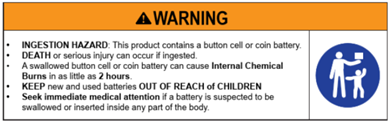
To ensure that products manufactured by Compal are fully safe under normal usage by preventing the six major hazards of accidental electric shocks, energy risks, mechanical injury, radiation, chemical hazards, and high-temperature burns from the product casing or internal parts/components, the product safety concept is incorporated by the Compal product safety department during the design phase for all Compal-produced notebooks, AIO desktop computers, and tablet PC products in accordance with the IEC 60950-1 and IEC 62368-1 international standards developed by the International Electrotechnical Commission (IEC). In-house testing is completed by the Compal safety lab before a third-party verification body is engaged for witness testing to ensure that all products (100%) meet international standards and obtain safety certification. The international safety certification standards are then used to apply for product safety certification in the designated country or region (e.g. Korea, India, Taiwan, North America, Europe, Middle East etc.) based on brand customer’s own market strategy. Therefore, "RCEM Certificate Management System," is utilized by Product Safety Certification department at Compal, featuring automation, fool-proofing mechanisms, and information of cross-facility connectivity. This allows the department to manage product certificate validity with optimal efficiency. In 2025, there were no violations of product safety specifications.


Sustainable Product Program
Compal's Sustainable Product Program is aligned with the second edition of the “Taiwan Sustainable Taxonomy” published by the Taiwanese Financial Supervisory Commission (FSC), which serves as the basis for product classification. To further advance sustainable product development, Compal aims to ensure that at least 80% of its products each year exceed minimum regulatory energy-efficiency requirements and obtain recognized environmental certifications, such as ENERGY STAR and EPEAT. To achieve these objectives, the Company continues to invest in research and development and optimize manufacturing processes through the following initiatives:
1. Advancing EPEAT 2.0 Green Material Applications:
To meet the forward-looking requirements of EPEAT 2.0, Compal is actively investing in research of low-carbon recycled material s. Compal is conducting in-depth validation of the reliability and material performance of incorporating post-consumer recycled (PCR) metals into product structures, ensuring both environmental benefits and product quality.
2. Enhancing Energy-Efficient Product Design (ENERGY STAR):
Compal’s Research and Development (R&D) teams dedicate critical technical resources to identifying and addressing system energy-consumption bottlenecks. Through continuous optimization of energy efficiency performance, the Company strives to ensure that its product portfolio meets ENERGY STAR certification requirements.
3. Promoting Smart Manufacturing and Process Optimization:
While maintaining a strong focus on high yield rates and production efficiency, Compal continues to deploy industrial automation technologies to replace conventional manual assembly and testing processes. For example, certain SMT testing operations have been upgraded from manual testing to automated robotic-arm testing systems. In addition, Automated Guided Vehicles (AGVs) and Autonomous Mobile Robots (AMRs) have been integrated into factory operations to support production automation, enhance operational efficiency, and establish intelligent manufacturing capabilities.
4. Establishing Smart Grids and Precision Energy Management:
Compal has deployed smart submeters across its manufacturing sites[LL4] and integrated them with its digital Energy Management System (EMS) to enable real-time monitoring of energy consumption data. Through data analytics and production scheduling optimization, the Company improves energy allocation efficiency and maximizes electricity utilization across production lines.
5. Employee Refresher Training:
Compal maintains a formal training material review and update mechanism. Whenever product specifications, environmental regulations, or technical requirements are revised, the Company proactively arranges targeted refresher training programs for R&D personnel based on project and functional needs. This approach helps ensure that employees remain up to date with evolving regulatory requirements and technological developments while maintaining the organization's technical and compliance capabilities.
Key Performance of Product Sustainability Stewardship
Compal has been committed to providing green products to the market and the clients for years, carrying out the concept of sustainability from cradle to grave, in every phase of product life cycle. From product design, material management, through manufacturing, product usage, to disposal and recycling, we uphold and show our belief of "minimizing environmental damage". We have set relevant KPIs to review the result of product sustainability management periodically.
By continuous tracking, evaluating and improving the KPIs, we persist in fulfilling our commitment to share and support the value of sustainability.
| Product Life Cycle |
Key Performance Indicators |
Performance of 2025 |
| Green Product Design |
Products covered by full life cycle assessment (ex: EPD) |
0.57% |
| Products covered by simplified life cycle assessment |
92.91% |
|
Other externally recognized tools
(ex: hazardous substance management according to EU REACH and RoHS)
|
5.17% |
| Total: Products covered by life cycle assessment |
98.66% |
|
Manufacturing
and Usage
|
Product certified with Type I eco-labels (ISO 14024) |
59.65% |
| Products certified with single/multi attribute eco- labels |
14.29% |
| Total: Products certified with Type I ecolabels or single/multi attribute eco- labels |
73.94%
(approximately NT$560.1 billion)
|
| Product Life Cycle |
Key Performance Indicators |
Performance of 2025 |
| Disposal/ Recycling |
Total weight of products under survey (tons) |
21,396 |
| Percentage of products and materials that were actually reused or recycled |
17.80% |
Sustainability Management of Raw Materials
Raw Materials Policy
Compal is committed to managing and utilizing raw materials in accordance with the principles of sustainable development, while actively engaging with both internal and external stakeholders. We are dedicated to searching for and developing procurement, application, and management models for raw materials that aim to reduce and minimize environmental and social impacts. Our goal is to pursue the sustainable development of both the environment and society. More detal please refer to Raw Material Policy of Green Product
Key Tracking Indicators of Sustainability Management of Raw Materials
| |
Amount of Materials
Used in Products (Ton)
|
Share of Materials Used That
Comes from Recycled Sources
|
| Plastic |
11,421.410 |
18.42% |
| Aluminum |
2,361.289 |
32.23% |
| Cobalt |
60.167 |
0.00% |
| Copper |
1,527.605 |
65.87% |
| Iron/Steel |
2,302.600 |
2.7% |
| Nickel |
14.252 |
0.43% |
| Lithium |
1.408 |
0.27% |
| Titanium |
0.295 |
0.02%
|