Inventory Methodology and Management Scope
To ensure the completeness, consistency, and traceability of greenhouse gas (GHG) data, the Company has established a GHG inventory management system and conducts regular GHG inventory, data consolidation, verification, and disclosure activities in accordance with international standards and internal management procedures. GHG emissions are quantified using the emission factor approach, which calculates GHG emissions based on activity data, emission factors, Global Warming Potential (GWP) values, and other relevant assumptions and input values. As this is the most widely adopted quantification methodology, this approach to measure its GHG emissions. During the reporting period, there were no changes to the methodologies, assumptions, or input values used to quantify GHG emissions.
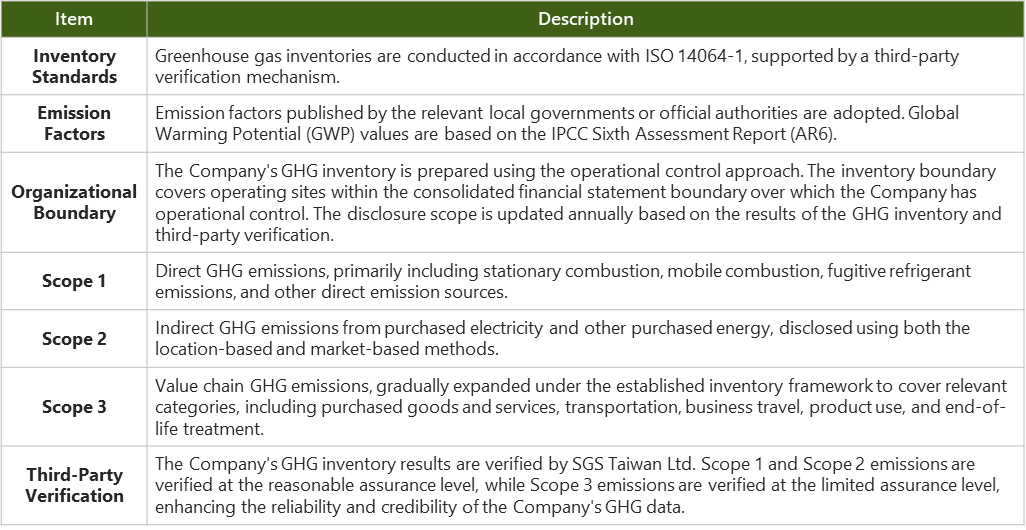
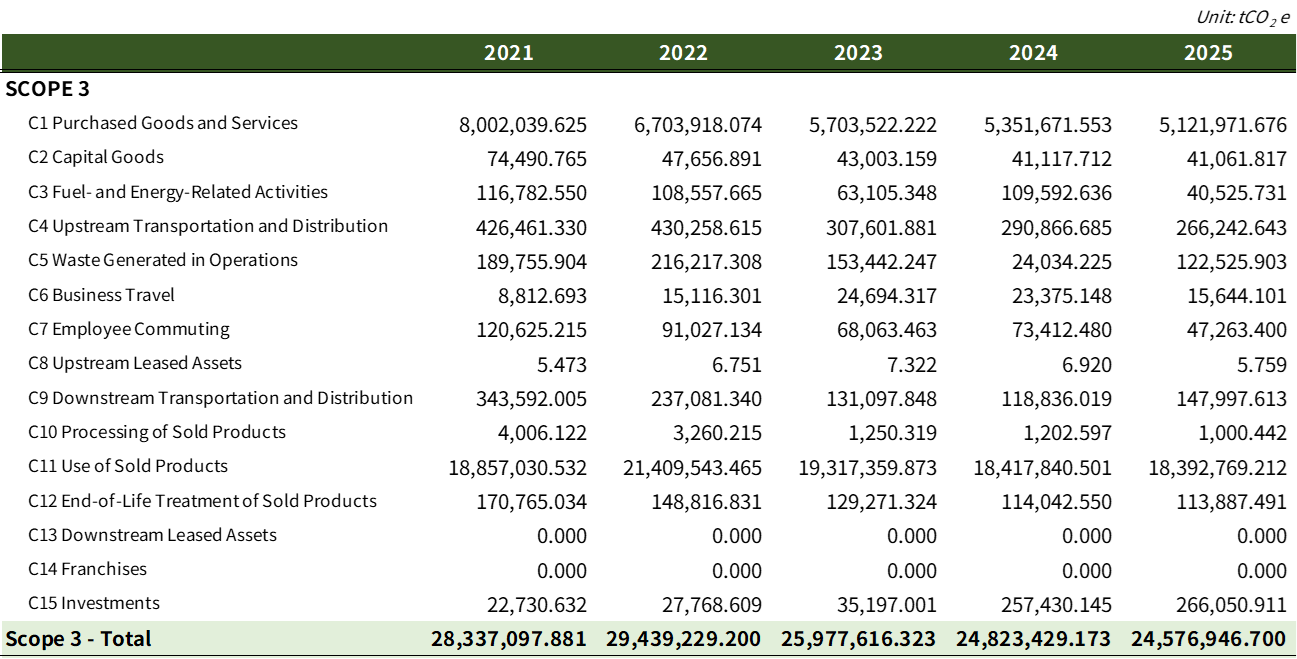
Scope 1 and Scope 2 GHG emissions are disclosed in the relevant tables of this report. Scope 3 value chain emissions are disclosed and updated through the Company's ESG website and other sustainability-related disclosures in accordance with the Company's sustainability disclosure plan.
Note: As the inventory year, data availability, and the scope of included value chain categories continue to expand, Scope 3 emissions should be interpreted based on the disclosure boundary and calculation methodology applicable to each reporting year.
Science Based Targets (SBT)
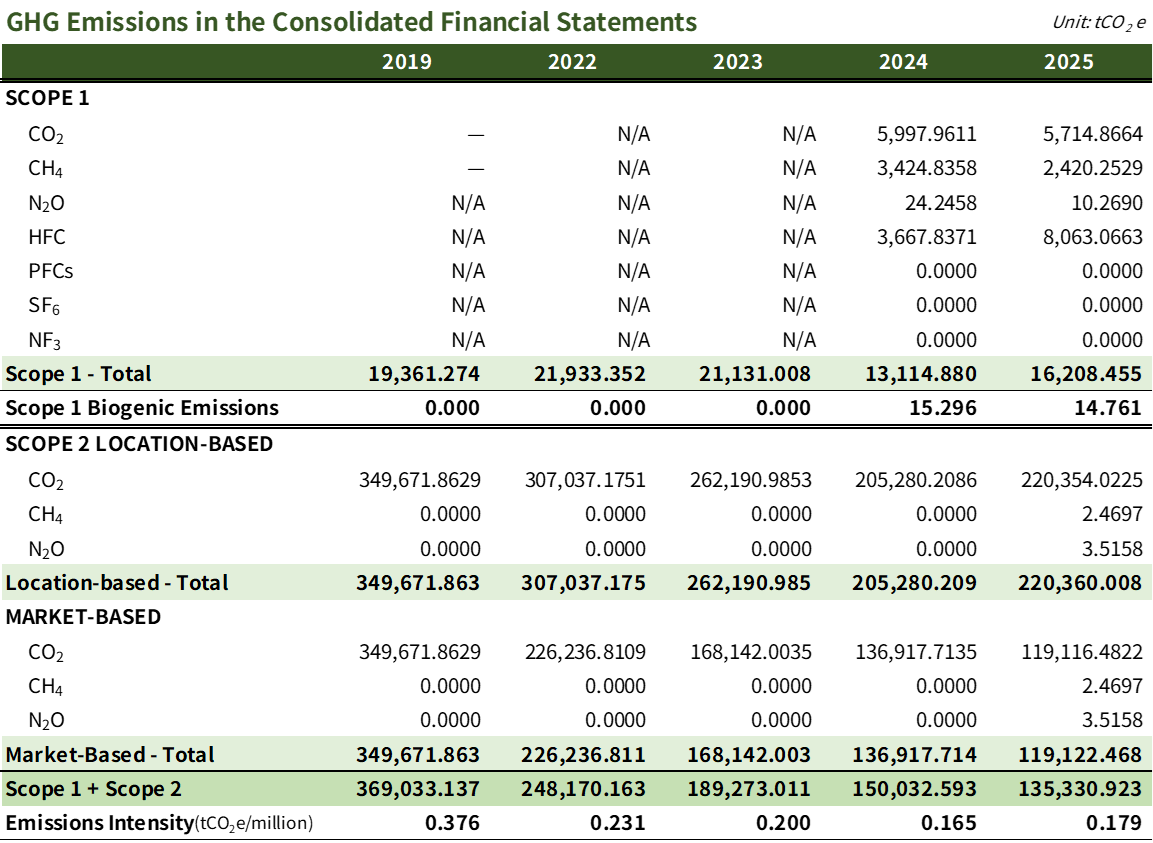

The 2025 GHG emissions results indicate that Scope 1 and Scope 2 emissions for both the Standalone Financial Statement Boundary and the Consolidated Financial Statement Boundary remain consistent with the phased decarbonization pathway established using 2019 as the base year. Overall emissions performance remains aligned with the Company's Science Based Targets (SBT) pathway and continues to progress toward its 2030 medium-term emissions reduction target. Based on market-based emissions, Scope 1 and Scope 2 emissions within the Consolidated Financial Statement Boundary decreased by 9.8% compared with the previous year, while emissions within the Standalone Financial Statement Boundary decreased by 33.5% year over year. These reductions were primarily driven by improvements in energy efficiency, the implementation of energy conservation projects, expanded use of renewable energy, and optimized renewable electricity allocation, all of which contributed to reducing GHG emissions from operating activities. The Company will continue to monitor emissions trends and incorporate energy consumption, renewable electricity allocation, production capacity changes, and the implementation of decarbonization projects into its annual management review to ensure continued progress toward its medium- and long-term emissions reduction targets.
Target Tracking and Decision-Making Integration
To ensure continued progress toward its decarbonization targets, the Company has incorporated greenhouse gas (GHG) emissions, energy consumption, renewable energy use, energy conservation projects, and the implementation of decarbonization initiatives into its annual management and performance monitoring mechanisms. Actual emissions are regularly reviewed against the Company's Science Based Targets (SBT) decarbonization pathway, and the results serve as the basis for adjusting management measures, allocating resources, and advancing the Company's climate transition plan. Target tracking results are analyzed through cross-functional review and management review mechanisms. Variations in emissions, progress toward reduction targets, energy efficiency, renewable electricity allocation, and changes in electricity demand at specific operating sites are evaluated to identify the underlying causes and opportunities for improvement. Based on the results, the responsible departments implement measures, including appropriate energy conservation improvements, optimization of energy allocation, renewable energy procurement, equipment replacement, and enhancements to operational management.
The Company‘s decarbonization targets are also progressively integrated into its resource allocation and investment evaluation processes. Decisions related to equipment investments, energy conservation projects, renewable energy procurement, and other low-carbon transition initiatives take into consideration emissions reduction benefits, energy costs, carbon costs, and investment feasibility, thereby strengthening the integration of decarbonization actions into operational decision-making. In addition, the internal carbon pricing mechanism will be progressively adopted as a management tool for carbon cost assessment and low-carbon investment decision-making, enabling responsible departments to incorporate carbon emission costs into project planning and investment evaluations. As the Company's digital platform continues to integrate emissions and energy data from operating sites, the Company will continue to enhance the efficiency of data collection, improve data timeliness, and strengthen cross-functional management capabilities. This will enable target tracking results to be incorporated into operational management, budgeting, capital expenditure planning and evaluation, and the execution of the climate transition plan, thereby reinforcing the alignment between decarbonization targets and the Company's long-term strategy.
Investment in Energy-Saving Equipment
In 2025, the Company continued to advance energy-saving investments across its sites, combining improvements in management mechanisms with upgrades to key equipment to progressively enhance overall energy efficiency.
In Vietnam, multiple energy-saving measures were completed in 2025, with a primary focus on strengthening energy management mechanisms, optimizing lighting systems, and introducing variable-frequency energy-efficient air-conditioning equipment. Total energy-saving investment expenditure for the year amounted to approximately NTD 14,158 thousand. These measures were completed and put into operation in 2025, forming an important foundation for overseas manufacturing sites to continuously reduce operational energy consumption and strengthen energy management capabilities.
Taipei Headquarters Chiller Replacement Project: To enhance the operational reliability and energy efficiency of the air-conditioning system, Compal plans to replace two 350 RT chillers at its Taipei headquarters, together with the associated turnkey works. Project planning, benefit assessment, and budget allocation were completed in 2025, with equipment replacement and construction scheduled for 2026. The total investment in equipment and related works is approximately NT$9.52 million. Upon completion, the project is expected to save approximately 280,000 kWh of electricity annually and reduce GHG emissions by approximately 118 tCO₂e per year. In addition to delivering energy-saving and carbon-reduction benefits, the project is expected to reduce the risk of unplanned downtime caused by aging equipment and improve the operational reliability of the air-conditioning system.
Overall, the Company is building on the energy-saving investment achievements completed in 2025 and aligned with the planned replacement of key infrastructure replacement in 2026. Through a phased, site-specific energy investment strategy, the Company continues to advance energy management refinement, supporting its medium- to long-term carbon reduction and operational efficiency improvement objectives.
Natural Carbon Sink Initiative
In 2025 and 2026, Compal supported natural carbon sink initiatives by investing approximately NT$200,000 annually to adopt around 0.5 hectares of organic tea farmland in the Pinglin area, promoting organic farming and grass-cover cultivation. By eliminating the use of chemical fertilizers, maintaining ground vegetation, and increasing soil organic matter, these practices help promote soil organic carbon accumulation, enhance soil carbon storage capacity, and strengthen carbon sequestration potential. Through continuous environmentally friendly land management, Compal supports the natural carbon sink function of agricultural soils and contributes to broader natural carbon sink and net-zero transition efforts.
According to soil fertility testing conducted by the Taiwan Agricultural Research Institute under the Ministry of Agriculture, soil organic matter at Parcel No. 340, Yuguang Section, an organically cultivated tea farm near the Pinglin area, increased from 2.14% in 2024 to 11.5% in 2026. Based on domestic studies and methodologies related to soil carbon sequestration from grass-cover cultivation in organic and eco-friendly tea farms, the estimated soil carbon sequestration potential is approximately 1 metric ton of CO₂e per hectare per year. Based on Compal’s adopted area of approximately 0.5 hectares, this is equivalent to an estimated potential soil carbon sink of approximately 0.5 metric tons of CO₂e per year.