Environmental Sustainability & External Advocacy
 Overall Environmental Sustainability Philosophy
Compal is committed to reducing the environmental impact of its operations, to build a company-wide environmental sustainability management framework. In accordance with the “ESG Sustainable Development Action Plan for TWSE and TPEx-Listed Companies” issued by the Financial Supervisory Commission (FSC), Compal has completed greenhouse gas inventories with subsidiaries included in consolidated financial statements and has passed the ISO 14064-1: 2018 standard with third-party independent verification to ensure the accuracy and credibility of environmental data.
To enhance environmental governance efficiency and data integration, Compal launched the Compal Cloud for Sustainability in 2024 as the central hub for group-level environmental management. This platform integrates environmental performance data on carbon emissions, energy, water, and waste, supports each site in target setting, implementation tracking, and performance feedback. It establishes a standardized framework for localized action, and enhances consistency and real-time responsiveness in environmental management.
Compal Environment Sustainability Policy
Compal is dedicated to balancing environmental, social, and economic development, pursuing “Sustainable Environment” and “Responsible Manufacturing” through strategies in “Climate Change Mitigation and Adaptation,” “Water Resourve Management,” “Energy Management,” and “Waste Management” to actively reduce environmental impact and achieve sustainability goals.
Compal's Commitments:
- Comply with environmental regulations and require suppliers, contractors, and logistics partners to follow our lead.
- Senior management leads environmental management units to set annual targets and action plans, with regular tracking to ensure performance achievement.
- Promote employee environmental education to enhance awareness and engagement.
- Establish transparent communication mechanisms to convey Compal’s environmental sustainability philosophy to internal and external stakeholders.
- Water resource management (WASH): Ensure all operational sites provide employees with safe drinking water, adequate sanitation facilities, and basic hygiene supplies. Adhere to international WASH (water, sanitation, and hygiene) standards to improve workplace hygiene and water use efficiency.
Policy implementation and management:
♦ Green Products and Services: Develop environmentally friendly products and promote the circular economy.
♦ Green Manufacturing and Operations: Optimize processes to reduce resource consumption, adopt automation and renewable energy, and minimize waste emissions.
♦ Green Transportation and Logistics: Reduce packaging, enhance transport efficiency, and minimize energy and resource consumption during transportation.
♦ Green Partners and Cooperation: Select supply chain partners with environmental commitments and align sustainability standards with merged or acquired entities. Compal will continue aligning with international standards, leveraging data-driven decision-making and innovative management to advance environmental sustainability and collaborate with the supply chain toward a net-zero future.
Compal will continue aligning with international standards, leveraging data-driven decision-making and innovative management to advance environmental sustainability and collaborate with the supply chain toward a net-zero future.
Green Product Design: Introduce central concepts of sustainable thinking.
Compal views green product design as the cornerstone of sustainable thinking. From the development stage, Compal considers the environmental impact across the entire product lifecycle—design, production, transportation, use, and disposal—strives to reduce resource consumption and carbon footprint at every stage, thus fulfilling responsibilities to the environment and users.
Environmental Management Strategy
Compal has established an implementation framework centered on governance structures, process standardization, data monitoring, and financial integration to ensure that environmental initiatives are effectively translated from strategic objectives into operational performance and continuous improvement.
oGovernance Structure and Division of Responsibilities: The Sustainability Committee under the Board of Directors oversees environmental policies and performance, while the ESG Office coordinates implementation across functions. Manufacturing, procurement, R&D, and finance functions execute management actions according to their respective responsibilities, ensuring that environmental management strategies are effectively implemented from the decision-making level through operational execution.
oProcess Standardization and Risk Management: Environmental and climate-related risks have been incorporated into the Enterprise Risk Management (ERM) framework. Through the adoption of internationally recognized standards, including ISO 14001, ISO 50001, and ISO 14064-1, the Company has established standardized management processes. In addition, Compal promotes UL 2799 Zero Waste to Landfill Certification to ensure the rigor of resource circularity management and the credibility of third-party verification, while maintaining consistent implementation standards across all sites.
oDigital Monitoring and Performance-Driven Management: The “Compal Cloud for Sustainability” platform is utilized to integrate data on energy consumption, water resources, and greenhouse gas emissions (including Scopes 1, 2, and 3) across all operational sites, enhancing data timeliness and accessibility. Monitoring data are directly linked to operational indicators and serve as a scientific basis for performance tracking, anomaly alerts, and capital expenditure (CAPEX) investment decisions.
oFinancial Integration and Investment Evaluation: Environmental indicators have been internalized as factors in financial evaluation. The Company utilizes its Internal Carbon Pricing (ICP) mechanism to assess the effectiveness of energy-saving projects and asset allocation decisions, ensuring that capital investments are aligned with the long-term decarbonization transformation pathway.
oFull Value Chain Management Approach: The management scope extends throughout the upstream and downstream value chain. Upstream, Compal empowers supply chain partners through supplier management mechanisms, training programs, and guidance on CDP disclosures to enhance suppliers’ carbon management maturity. Downstream, product carbon footprint assessments and circular economy principles are incorporated into the design phase to reduce environmental impacts during product use and end-of-life stages.
Through KPI tracking and rolling improvement mechanisms, the Company continuously enhances management effectiveness, forming a complete sustainability management loop that links the identification of risks and opportunities discussed in Sustainbiliy Report Chapter 4 with strategic implementation and execution.
Responding to International Advocacy and Cooperative Actions
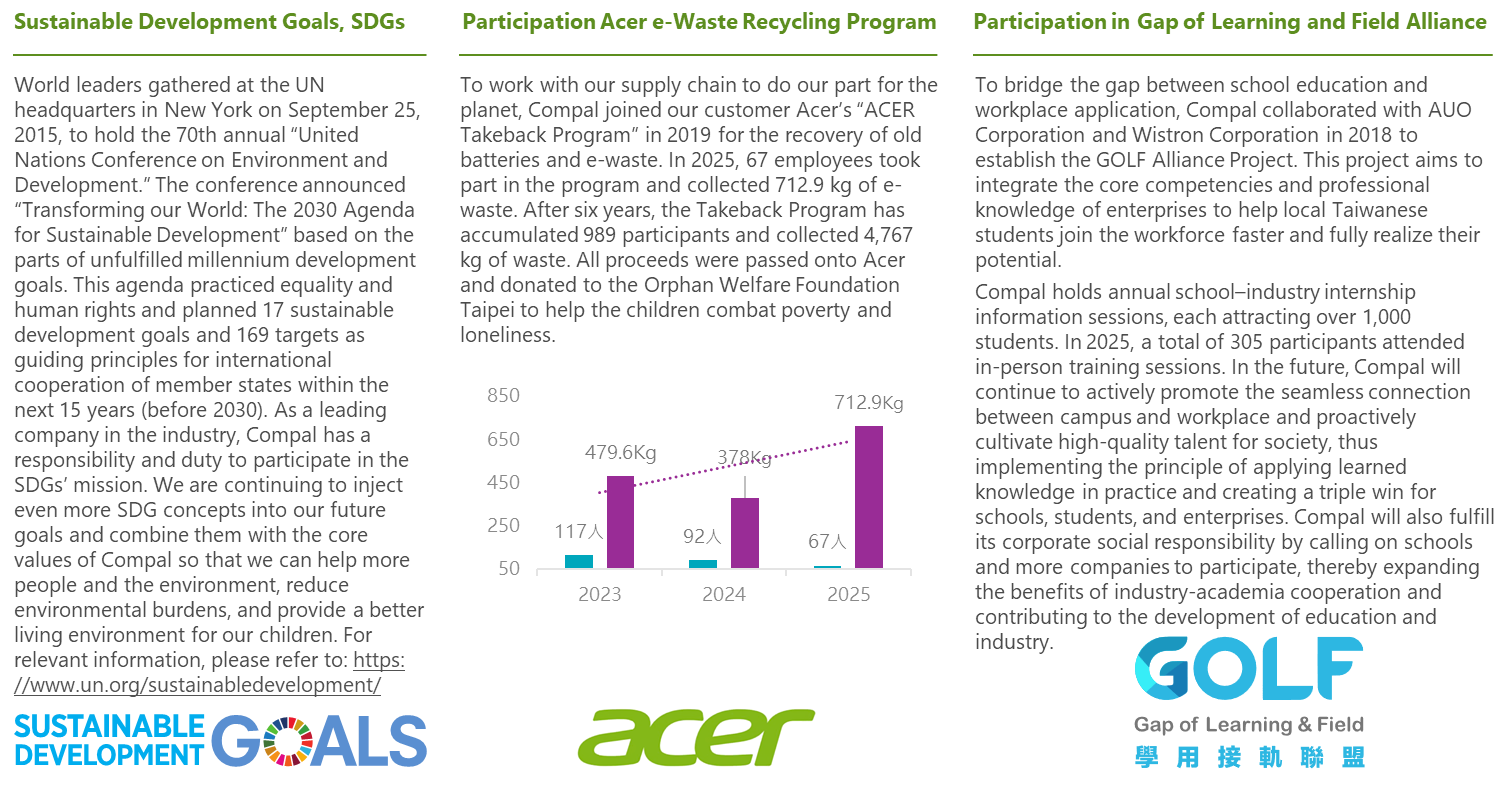
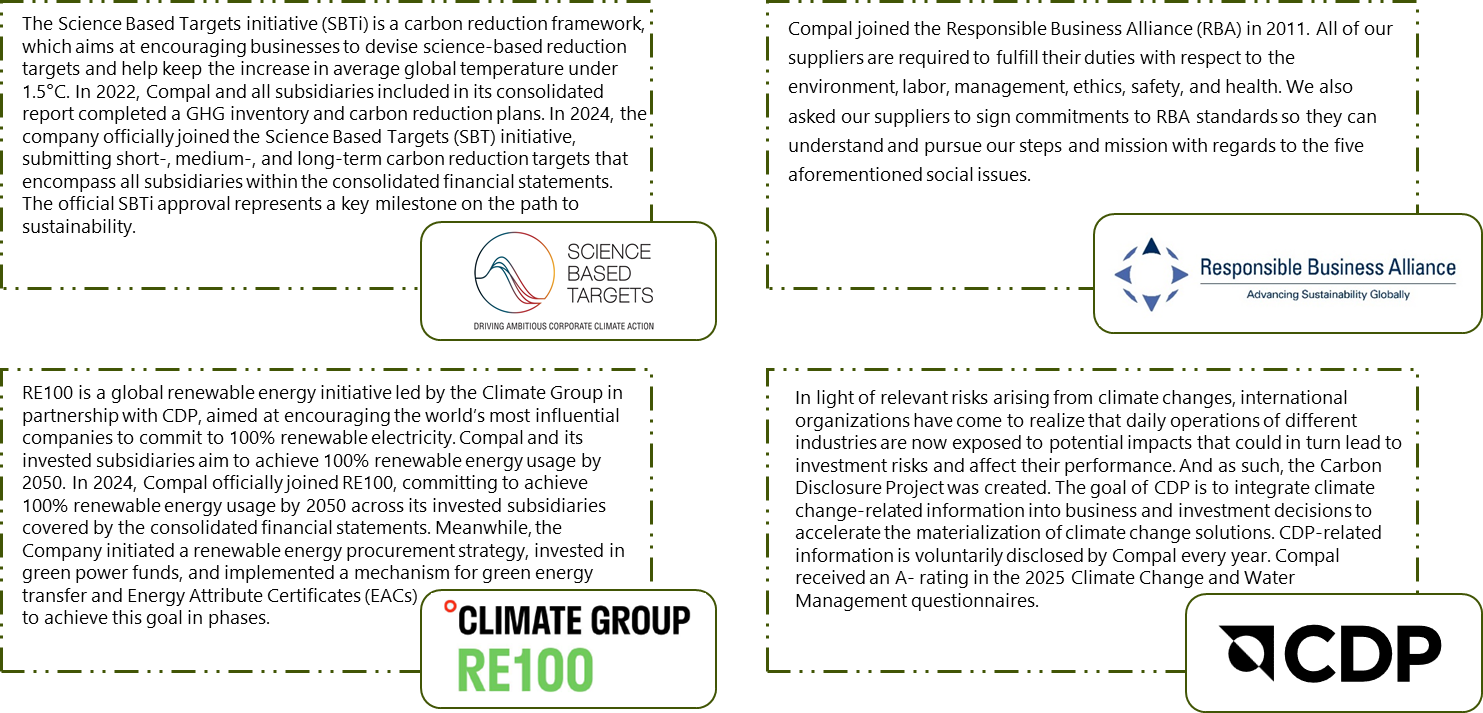
Compal is actively responding to international climate and sustainability initiatives by engaging in practical participation, disclosure, and collaborative projects. The company promotes climate governance mechanisms and accountability practices both internally and externally, while establishing a long-term action framework aligned with Sustainable Development Goals (SDGs). Compal is also proactively involved in international governance, policy collaboration, and industry initiatives. With a better understanding of the nature and objectives of each engagement, external collaborative actions are categorized into responses to international governance initiatives, customer collaboration participation, academic-industry cooperation initiatives, and supply chain engagement: